

Kind of. A mortgage broker helps you find and compare mortgage deals from different banks and mortgage lenders. Instead of you contacting different banks one by one, the broker does much of this work for you. A mortgage advisor helps you understand which mortgage is suitable for you. First, they understand your financial situation, answer your questions, guide you, and help you choose a mortgage that you can afford and that suits your needs.
And you know what, we are both a specialist mortgage broker and a mortgage advisor. We have access to 190+ lenders so that we can explore different mortgage deals and options based on your income, deposit, and financial situation. We take the time to understand your needs, explain the available options, and help you find a mortgage that suits your circumstances.
What is a Mortgage Advisor or Mortgage Broker?

A mortgage advisor is a qualified professional who recommends a mortgage that suits your income, deposit and plans. A mortgage broker is the go-between who searches lenders for you and handles the application. In the UK, 80% one person usually does both jobs, which is why the titles get mixed up.
Both need to be authorised by the Financial Conduct Authority (FCA), or work as an appointed representative of a firm that is. That is more than paperwork. It means they must follow strict rules on useful advice and fair treatment of customers.
So when someone calls themselves a broker, they are usually an advisor too. Usually. The exceptions come next.
What is the Difference Between Mortgage Advisor and Broker?

The main difference is how many lenders they can reach and who they work for. A broker is normally independent and compares deals across the market. An advisor employed by a bank can usually only recommend that bank’s own mortgages.
There is a second twist. Some brokers work on an execution only basis. They arrange the mortgage you pick, but they do not tell you whether it is the right one for you or not. If you are unsure about your choice, look for a specialist mortgage broker who gives you the right advice.
A quick way to tell them apart:
-
- Bank advisor: one lender, that lender’s products only. Think of a shop that sells just one brand. The person helping you may be lovely, but they can only show you what is on their own shelves. If their bank’s mortgage is not the best one for you, they cannot point you somewhere else.
-
- Independent broker: many lenders, compares options for you. Think of a big shop with lots of brands under one roof. The broker looks across many lenders, lines the choices up side by side, and helps you pick the one that fits your life and your budget.
-
- Execution-only broker: arranges what you choose, with no personal recommendation. Think of a delivery service. You pick the mortgage yourself, and they simply book it and send in the paperwork. They will not tell you whether your pick is a good one, so that decision stays with you.
Key Points
-
- In the UK, advisor and broker often mean the same person. The two job titles get swapped all the time. So if one company says advisor and another says broker, do not assume both are different. Ask what they actually do for you.
-
- They should be FCA authorised, or work for a firm that is. The FCA (Financial Conduct Authority) is the UK’s rule-keeper for financial advice, a bit like the referee in a football match. If your mortgage person is not authorised, and is not working under someone who is, do not go ahead. You can check the FCA Register in a couple of minutes.
-
- The real difference is lender choice, not job title. What matters is how many lenders they can look at. Someone who can search 100 lenders has a much better chance of finding your match than someone who can only search one. The title on a business card tells you very little.
-
- Some lenders only accept applications through brokers. Certain lenders do not deal with the public at all. They only take cases from brokers. If you walk into a bank or apply online yourself, you will never even see these deals. A broker can.
-
- Fees vary from firm to firm, so ask before you commit. Some brokers charge you a fee, some are paid by the lender, and some do both. None of these is automatically bad. The key is to ask, what will I pay, and when? Do it before you say yes, so there are no nasty surprises later.
-
- Self-employed buyers, landlords and first-time buyers tend to gain the most. These groups often do not fit the neat box lenders like. A first-time buyer is new to it all. A self-employed person has income that goes up and down. A landlord has rent to think about. An independent broker knows which lenders are comfortable with each situation, so you avoid a string of rejections.
Mortgage Advisor vs Mortgage Broker
Here is how the two usually compare. Remember, an adviser at a broker firm works the same way as a broker.
| Mortgage advisor (bank) | Mortgage broker (independent) | |
| Main job | Recommends from one lender’s range | Searches the wider market for you |
| Works for | The lender | You (and is paid by you, the lender, or both) |
| Lender choice | One | Many |
| Advice | Yes, limited to that lender | Usually yes, on full-advice service |
| Handles the paperwork | Often | Yes, from search to completion |
| Cost | Usually no separate advice fee | Varies, so ask upfront |
Not sure which one you need? Tell us a little about your situation and we will point you in the right direction. You can start by asking for a mortgage quote from BM14 Finance.
Not sure which one you need? Tell us about your situation and we will point you in the right direction.
Book an Appointment NowWhat Do Mortgage Advisors Do?

A mortgage advisor looks at your whole financial circumstances, then recommends a mortgage that fits them. They explain the options, check what you can afford, and tell you what is risky as well as what is cheap.
In practice, that covers:
-
- Working out how much you could borrow.
-
- Checking your deposit, income and monthly outgoings.
-
- Explaining fixed, tracker and variable rates.
-
- Recommending a product, not just the lowest headline rate.
-
- Talking you through fees, early repayment charges and what happens when your deal ends.
Here is the bit most people miss. The lowest rate on the screen is rarely the cheapest mortgage. A hefty product fee here, a steep early repayment charge there, and the bargain stops looking like one. A good advisor does the sums you cannot see.
What Does a Mortgage Broker Do in the UK?
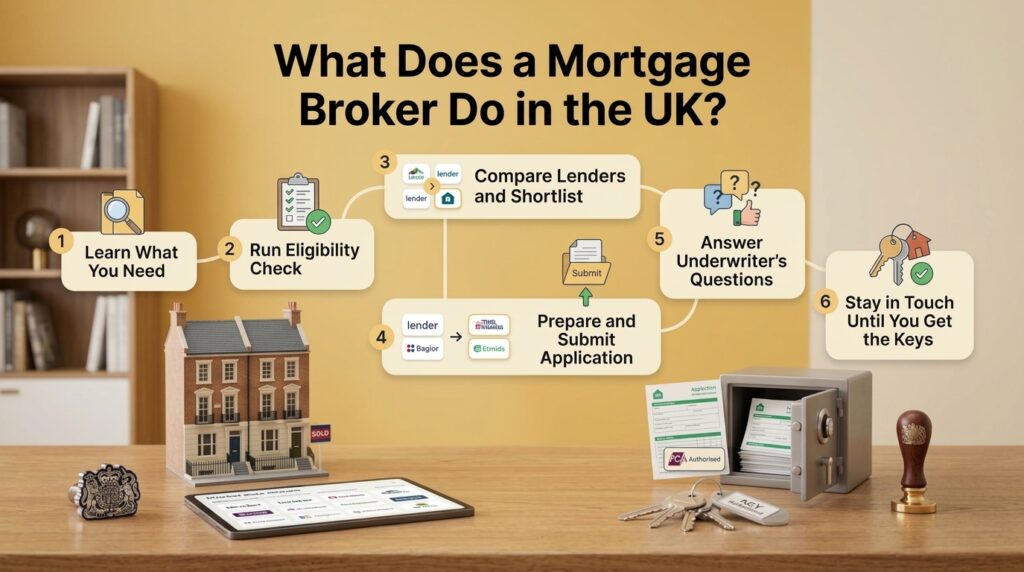
A UK mortgage broker searches the lender market for you, submits your application and keeps it moving until completion. They deal with the lender, the estate agent and the solicitor, so you are not chasing three different people on your own.
A typical broker will:
-
- Learn what you need and what you are hoping for.
-
- Run an eligibility check.
-
- Compare lenders and shortlist the best matches.
-
- Prepare and submit your application.
-
- Answer the underwriter’s questions along the way.
-
- Stay in touch with your solicitor until you get the keys.
There is a hidden benefit too. Two lenders can look at the same payslip and reach different ending. A broker knows which lender tends to say yes to your type of case, which saves you from a pile of declined applications.
Advantages of Using a Mortgage Broker
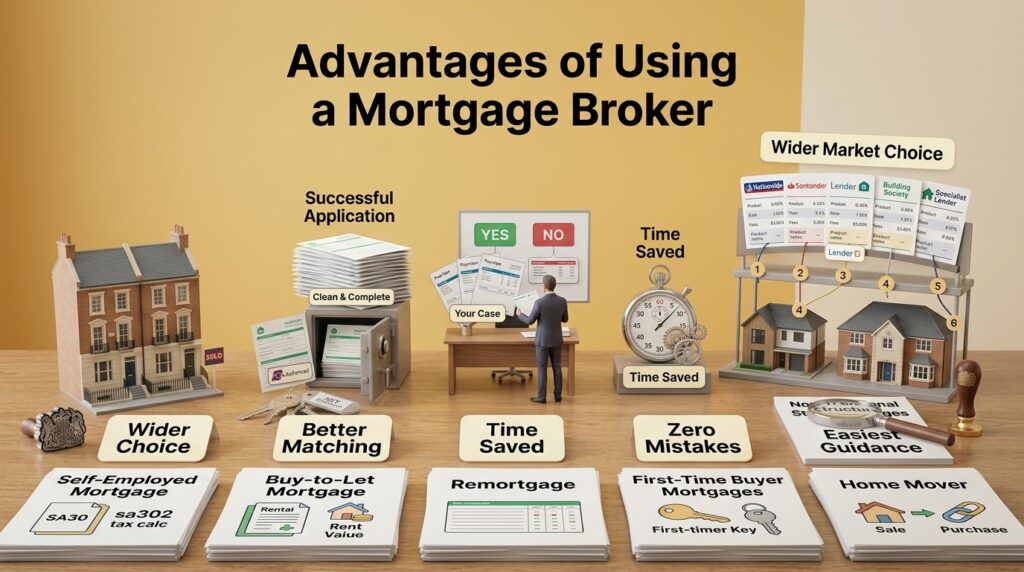
The biggest advantage is choice. Beyond that, you save time, avoid avoidable mistakes and get a person on your side when things get complicated.
-
- Wider choice: access to mainstream lenders, specialist lenders and some deals you cannot get by walking into a branch.
-
- Better matching: your case goes to lenders likely to accept it, which protects your credit file from unnecessary rejections.
-
- Time saved: the research, forms and chasing are handled for you.
-
- Fewer errors: a clean, complete application moves faster through underwriting.
-
- Easiest guidance: you understand what you are signing before you sign it.
Want to see how nationwide mortgage rates stack up against a building society or a specialist lender? A broker lays them one by one. And since lenders change their rates often, sometimes within days, having someone watching the market is a real help.
Non-Traditional Structure Mortgages
Lenders love a tidy application: one permanent job, a big deposit and spotless credit. Real life is rarely that neat. If your finances have a few extra moving parts, this is where a broker earns their keep.
Self-Employed Mortgage
Being your own boss does not stop you from getting a mortgage. It just means lenders look harder at your paperwork. Most ask for two to three years of accounts or SA302 tax calculations, though some will consider less.
Here is the interesting part. Lenders don’t all calculate your income the same way. Some use an average of your last two years, some take the latest year, and some take the lower figure. The same business can look very different depending on who is reading the numbers.
Buy-to-Let Mortgage
Letting out a property changes the rules. Lenders usually care about the rent as much as your salary, and many expect the rent to cover your mortgage payments with room to spare. Deposits are often bigger too, commonly around 25%.
If you are weighing up a purchase, read our guide to buy to let mortgage requirements first. A rental mortgage calculator can also give you a quick feel for whether the numbers stack up before you book a viewing.
Our adviser is a landlord as well, so these conversations come from lived experience, not just a lender’s rulebook. Voids, repairs and tenant changeovers are not abstract ideas here.
Remortgage
When your fixed rate ends, most lenders move you onto their standard variable rate, which is often higher. Many lenders let you lock in a new deal up to six months before your current one expires.
That means the best time to look is earlier than most people think. A broker can compare your current lender’s new deal with the wider market, so you do not just accept whatever lands in your inbox.
First-Time Buyer Mortgages
Buying your first home feels like learning a new language. Deposits, stamp duty, solicitors, surveys, and a mortgage on top. A mortgage advisor for first time buyers helps you take it one step at a time, starting with what you can realistically borrow and what you will need to save.
There is help available, too. From Lifetime ISA bonuses to shared ownership, it pays to know the first time buyer benefits that could apply to you before you start house-hunting.
Home Mover
Moving home means juggling two deals at once: the one you are leaving and the one you are starting. Can you take your current rate with you? Do early repayment charges apply? How much equity are you carrying across?
A broker maps this out before you put your home on the market. Timing a sale and a purchase is stressful enough without a surprise charge halfway through.
Want more than one broker working for you? We work with 190+ lenders and explain every option in the easiest way.
Contact NowCase Study of a Mortgage Broker and Mortgage Advisor
Illustrative example based on a very common situation. Not a named client.
Daniel is a self-employed electrician in London. He has two years of accounts and a 10% deposit. He walked into his high street bank and spoke to an advisor there.
The answer was disappointing. His first year had been quieter than his second, and the bank used the lower figure. That cut what he could borrow below what he needed.
A broker looked at the same accounts and found a lender that assessed self-employed income on a two-year average. Same Daniel, same business, same paperwork. Different lender, different result.
What this shows:
-
- The advisor was not wrong. They could only apply one lender’s rules.
-
- The broker was not magic. They simply knew where to look.
-
- Lender choice, not job title, decided the outcome.
Sound familiar? If your situation is anything but standard, a conversation with our team could save you weeks of stress. Take a look at the mortgage application process we follow to see how we would handle it.
Is your situation anything but standard? A quick chat with us could save you from stress.
Call NowShould You Use a Mortgage Broker or Adviser?

Yes, definitely. If you are self-employed, a first-time buyer, a landlord, or have a few blemishes on your credit history, independent advice is usually worth it.
There are cases where going direct is fine. A simple remortgage with your existing lender, with no change to your borrowing, can be quick to do yourself. Even then, it is worth checking that the lender’s new deal is competitive.
A quick test. Ask yourself:
-
- Is my income anything other than a single salary?
-
- Do I need to borrow close to the maximum?
-
- Do I have a smaller deposit than most?
-
- Have I had missed payments or defaults?
-
- Am I buying to let, or moving with a chain involved?
If you said yes to even one, a broker is probably worth a call. And before you sign up with anyone, you can check their status on the FCA Register.
What Will a Mortgage Broker Want to Know?

A broker wants to understand your income, your outgoings, your deposit and what you are trying to achieve. The more complete the picture, the better the advice, and the fewer surprises later.
Expect questions about:
-
- Your job, income and how long you have been in it.
-
- Your monthly bills, loans and credit cards.
-
- Where your deposit is coming from.
-
- Your credit history.
-
- The property you are looking at, or the one you own.
-
- Your plans for the next few years, such as children or a career change.
You will also need some paperwork. Usually that means ID such as a passport or driving licence, bank statements showing your deposit, your last three payslips, or tax returns if you are self-employed. Lenders can ask for more in some cases.
Ready to talk it through? Ask for a mortgage quote and we will take it from there.
Ready to see where you stand? Share a few details and we will take it from there.
Get a Mortgage QuoteHow Long Does a Mortgage Advisor Appointment Take?
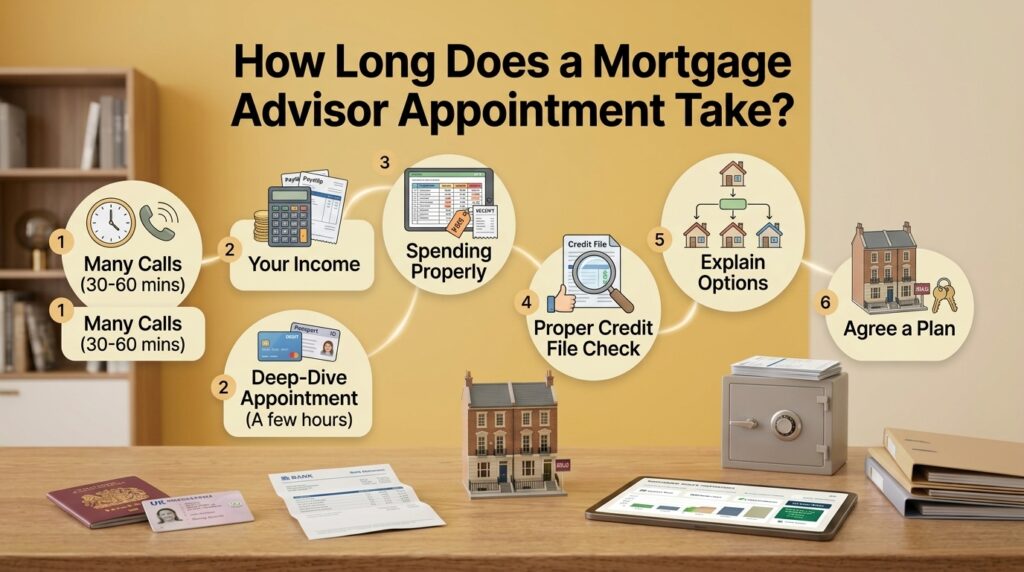
Many initial calls last around 30 to 60 minutes. An appointment with BM14 Finance takes a few hours.
Yes, a few hours. It sounds long until you see what happens in that time. We go through your income, spending and credit file properly, we explain your options, and we agree a plan, all in one sitting. Most clients tell us they would rather do it once than have five rushed calls.
The upside is simple. By the time you leave, you know your budget, your options and your next step.
How Long Does a Mortgage Application Take Through a Broker?
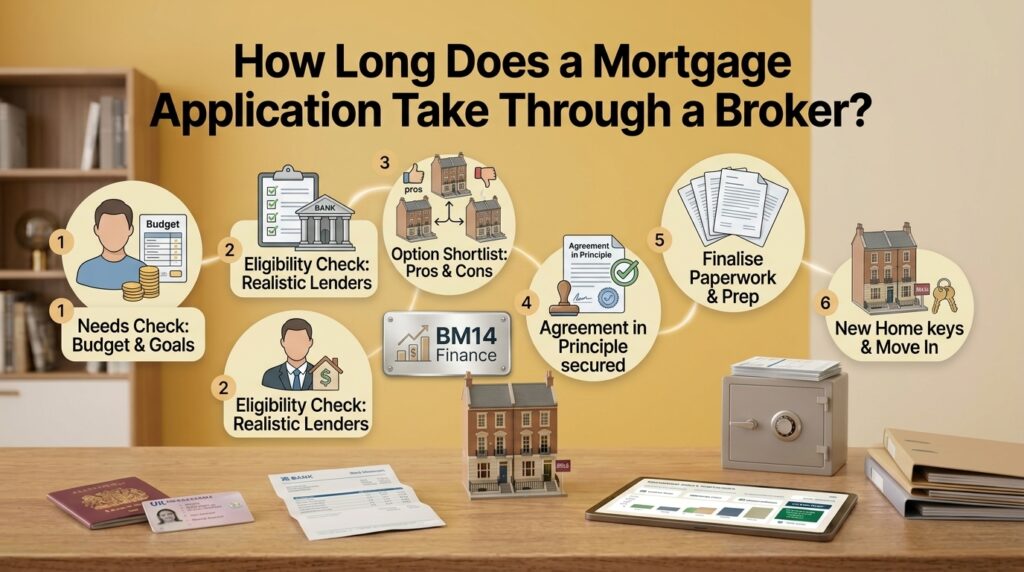
With BM14 Finance, the whole process can take as little as 6 weeks. Some cases move faster. Others take longer, often because documents arrive late or the property chain is slow.
Here is how it usually goes:
-
- We learn what you need. Budget, timeline and goals first.
-
- We check your eligibility. So we know which lenders are realistic.
-
- We shortlist the best options. And explain the pros and cons of each.
-
- We secure an Agreement in Principle. This is the lender’s early view of what it could lend you, based on the terms and rate you are likely to get.
-
- We finalise the paperwork. Then we get you ready for your new home
One tip from experience: The quickest way to speed things up is to get your documents ready early. A neat folder of payslips and statements can shave days off.
Get right, honest mortgage advice from someone who has been on both sides of the table.
Book an Appointment NowWhy speak to BM14 Finance?
BM14 Finance is a UK financial advisory, mortgage and insurance company. Here is who you would be talking to.
-
- Experience: Your adviser has more than 20 years of experience in customer service and corporate account management, and is a landlord too. Muhammad S. Rasheed completed their mortgage studies in 2024 and became an Appointed Representative of Connect Mortgages in November 2024.
-
- Expertise: We help first-time buyers, remortgagers, landlords and home movers with both residential and commercial lending. We also cover development finance, bridging finance and protection.
-
- Choice: We work with mainstream lenders such as Barclays, HSBC, Nationwide, Halifax, Santander and Metro Bank, plus specialist lenders and 190+ others.
-
- Trust: we are an Appointed Representative of Connect Mortgages, which is authorised and regulated by the Financial Conduct Authority.
Where to find us: Our office is in Berkeley Square House, Mayfair, London W1J 6BD, UK, and Hempstead, Kent (ME7). We support clients in London and across the UK.
Ready to talk? Book an appointment with BM14 Finance and get clear, honest mortgage advice from someone who has been on both sides of the table.