

A landlord we spoke to last month put it best: “Every time I think I’ve got my head around the rules, someone moves the goalposts again.”
He’s not wrong. Buy to let used to be fairly simple: save a deposit, find a property, get a mortgage, collect the rent. Now there’s a stress test to pass, a tax bill that looks nothing like it did 5 years ago, and lenders asking questions they never used to ask. Some landlords are walking away from the market entirely. Others are quietly working out how to make the new rules work in their favour.
This guide is for the second group. No jargon, no guesswork, just what’s actually changed in 2026, what lenders check today, and what it means the next time you apply for, remortgage, or convert buy to let mortgage loans.
What is a Buy to Let Property?

Before we get into the rule changes, it helps to be clear on what we’re actually talking about.
A buy to let property is a home you buy specifically to rent out, not to live in yourself. You’re the landlord, someone else pays you rent to live there, and the mortgage you take out to fund it is a buy to let mortgage rather than a standard residential one.
This matters because lenders treat buy to let applications completely differently to residential ones. Instead of looking mainly at your salary, they look at the rent the property can realistically bring in. That single difference is why so many of the new rules focus on rental income rather than personal income.
What is a Let to Buy Mortgage?

Here’s a mix-up that catches a lot of people out, and it’s got more confusing since the newer rules came in.
A let to buy mortgage works the other way round to buy to let. It’s for people who already own a home, want to move into a new one, and would rather rent out their current property than sell it. So you remortgage your existing home onto a let to buy deal, and take out a separate residential mortgage on the new place.
Buy to let is about buying a property specifically to rent it out from day one. Let to buy is about turning a home you already live in into a rental, usually because you’re moving on but don’t want to give it up. The paperwork, the lender criteria and the rental income calculations are similar for both, but the starting point is different, and it’s worth being clear on which one applies to you before you start filling in forms.
Looking for a Buy-to-Let Mortgage?
Let BM14 Finance help you explore your options.
Buy to Let Mortgage Requirements

This is where the real changes start to show up.
Lenders generally want to see:
- A deposit of at least 25% of the property’s value (some will go to 20% or even 15%, but you’ll pay for it in a higher rate).
- Rental income that comfortably covers the mortgage repayment, tested at a stress rate rather than your actual rate.
- A personal income, usually a minimum of around £25,000 a year from employment or self-employment, though this varies by lender.
- A credit history, though a few specialist lenders will consider you with past credit issues.
- You’re usually expected to be at least 21, sometimes 25, and under a maximum age at the end of the mortgage term, which is typically 75 to 85 depending on the lender.
What’s changed recently is how strictly that rental income figure gets checked. Lenders have tightened up the maths behind it, which we’ll come to shortly.
Buy to Let Mortgage Criteria

Criteria and requirements overlap, but criteria go a layer deeper, and this is the part that’s been getting stricter.
On top of the basics above, most lenders now also ask for:
- Proof you already own your own home, or have owned property before, for most standard buy to let products (though there are first-time buyer and first-time landlord options, covered further down).
- More detailed paperwork on your income and outgoings than a few years ago, partly driven by wider affordability rules across the mortgage market.
- Evidence of how the property will be let, for example whether it’s a standard tenancy, a House in Multiple Occupation, or a holiday let, since each has its own lending criteria.
- For portfolio landlords with four or more mortgaged properties, a full breakdown of the whole portfolio’s finances, not just the property being mortgaged.
None of this is designed to catch landlords out. It reflects lenders wanting more certainty that rental income will actually cover the mortgage if costs rise, which is the same thinking behind the rental income calculation changes below.
Get a Buy to Let Mortgage

With the criteria in mind, here’s how the process actually works in practice.
- Work out your numbers first. Deposit, expected rent, and your own income and outgoings. This tells you roughly what you can borrow before you fall in love with a property you can’t afford.
- Speak to a broker or adviser. Buy to let lending has enough variation between lenders that going direct to one bank often means missing better options elsewhere. This is exactly where BM14 Finance comes in. Instead of sending you to one lender, we go through our panel of mainstream and specialist lenders to find the deal that actually fits your situation, not just the first one that says yes.
- Get an Agreement in Principle. This gives you a lender’s initial view of how much you could borrow, based on a quick check of your income, credit history and outgoings. It’s not a full offer, but it shows agents and sellers you’re serious. At BM14 Finance, this is usually a same-day turnaround, so you’re not left waiting around while a good property gets snapped up by someone else.
- Submit the full application. This is where the detailed rental income and affordability checks happen. The mortgage application process for buy to let asks for more documentation than a standard residential one, proof of rental income, existing portfolio details if you have other properties, and a closer look at your outgoings, so having someone who knows the paperwork inside out genuinely saves you time.
- Valuation and underwriting. The lender values the property and confirms the rent is realistic for the area.
- Formal mortgage offer. Once everything checks out, you get a full offer and move to legal completion.
Done properly, with documents ready in advance, this whole process can take as little as 4 to 6 weeks from application to completion at BM14 Finance, though it can run longer if there are gaps in paperwork or the property needs extra checks. If you’d rather not navigate all six steps on your own, that’s the whole point of having BM14 Finance in your corner; we handle the back and forth with lenders so you’re not chasing paperwork on top of everything else.
Ready to Get a Buy-to-Let Mortgage?
Speak to BM14 Finance today to discuss your mortgage needs.
Buy to Let Mortgage for First Time Buyer

A fair number of people ask whether you can buy a rental property before you’ve ever owned a home yourself. The answer is yes, but the options are narrower.
Most mainstream lenders want to see that you already own or have owned residential property. This is partly about experience as a homeowner, and partly about risk, since a first-time buyer taking on a rental property with no prior mortgage history is a different proposition to an existing homeowner doing the same.
That said, a number of specialist lenders will consider first-time buyer, first-time landlord applications. You’ll usually need:
- A larger deposit, often 25% to 30%.
- Strong, provable personal income.
- A clean credit file.
- Sometimes, a guarantor or additional security.
It’s worth weighing this against going the traditional route first. Buying your own home before stepping into buy to let often works out easier, since it means you’ll have already built a mortgage track record, and you may still be able to access first time buyer benefits like lower deposit schemes and stamp duty relief on that first purchase, something you lose access to once you already own property.
If this is you, it’s worth speaking to an adviser early. Going in without knowing which lenders will even consider first-time buyer buy to let applications is one of the most common ways people waste time on a purchase that was never going to complete.
Buying Your First Buy-to-Let Property?
Speak to BM14 Finance for expert mortgage guidance.
Buy to Let Mortgage Based on Rental Income
This is the section where most of the actual rule changes live, so it’s worth taking slowly.
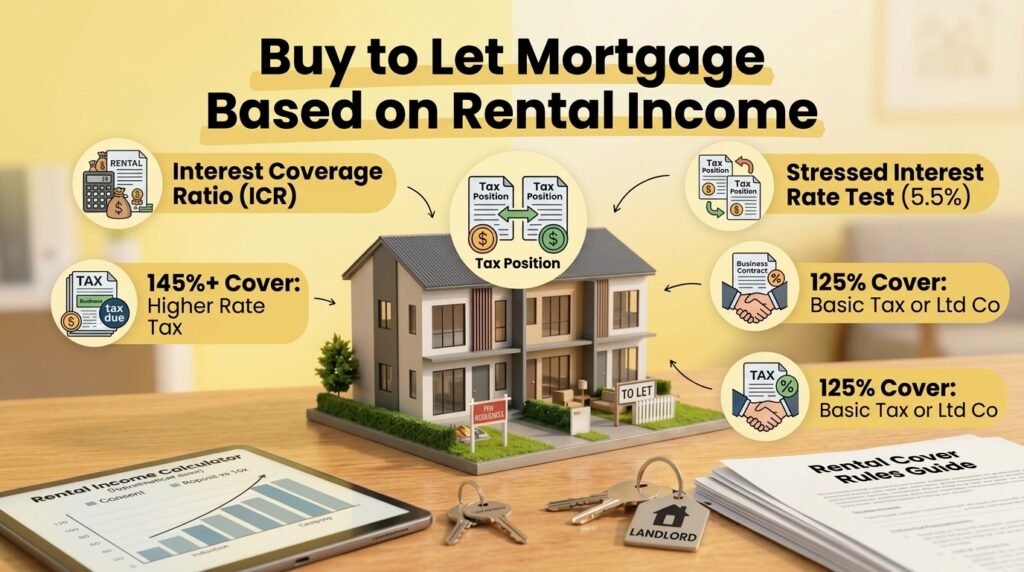
Buy to let lending is built around one core question: does the rent cover the mortgage, with room to spare? Lenders answer this using something called the Interest Coverage Ratio, or ICR.
Here’s how it works. The lender doesn’t just check that rent covers your mortgage payment at today’s rate. They test it against a higher, hypothetical rate too, usually around 5.5%, regardless of the rate you’re actually being offered. They also want the rent to sit comfortably above that stressed figure, not just match it.
The exact buffer depends on your tax position:
- Basic-rate taxpayers, and most limited company applications, are usually tested at 125% rental cover.
- Higher rate and additional rate taxpayers are tested more strictly, often at 145% or more.
Why the difference? Since mortgage interest is no longer deducted from rental income before tax, higher rate taxpayers keep less of their rental profit after tax than they used to, so lenders build a bigger safety margin into the sums.
In practice, this means the same property might be mortgageable for one landlord but not another, purely because of how they’re taxed. If you’re not sure where your numbers land, running them through a rental mortgage calculator before you make an offer on a property will save you a wasted valuation fee and frustration.
Check Your Buy to Let Mortgage and Rental Income
Use our mortgage calculator and rental calculator to see how your rental income affects what you can borrow.
How Much Can I Borrow Buy to Let Mortgage
Follow on from the rental income rules above, and the honest answer is: it depends far more on the rent than on your salary.
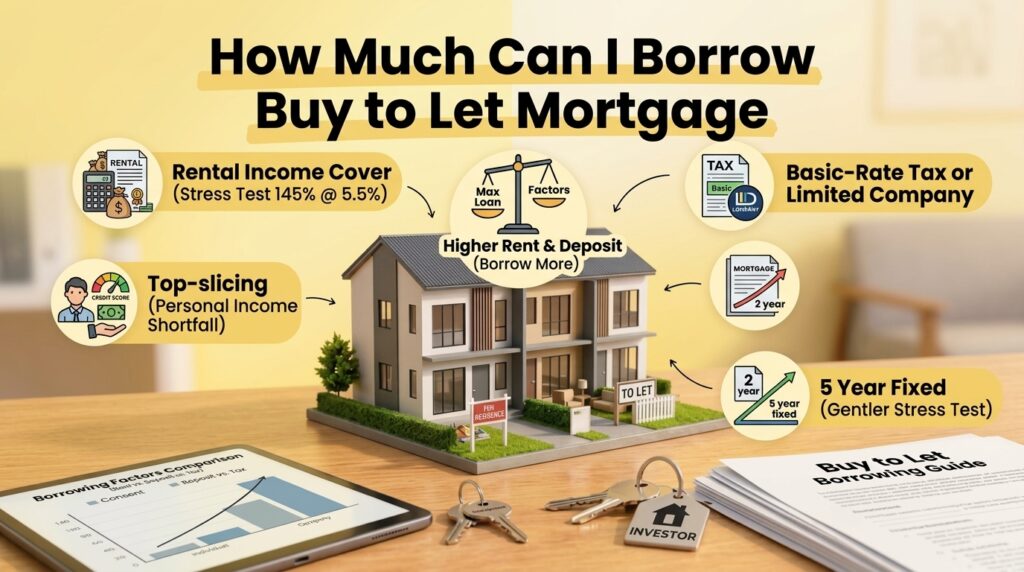
As a rough guide, lenders typically work backwards from the rent. If a property rents for £1,200 a month, and the lender needs 145% cover at a 5.5% stress rate, the maximum loan they’ll offer sits well below what your personal income alone might suggest you could afford.
A few things push your borrowing up or down:
- Higher rent relative to property value increases what you can borrow.
- A bigger deposit reduces the loan needed, which makes the stress test easier to pass.
- Basic-rate tax status, or buying through a limited company, generally allows more borrowing than buying as a higher rate taxpayer in your own name.
- Top-slicing, where a lender allows your personal income to make up a rental shortfall, is offered by some lenders and can unlock borrowing that wouldn’t otherwise pass.
If your numbers are tight, it’s often worth exploring whether a 5 year fixed rate helps, since some lenders apply a gentler stress test on longer fixes than 2 year deals.
How Much Can You Borrow for a Buy-to-Let Mortgage?
Speak to BM14 Finance today to discuss your borrowing options and find a mortgage that suits your needs.
Buy to Let Mortgage Deposits
Deposits are one of the areas where buy to let has always been stricter than residential lending, and that gap hasn’t closed.
Where a residential mortgage might ask for 5% or 10% down, buy to let typically starts at 25%. A handful of specialist lenders will go to 20%, and in limited circumstances 15%, but expect a noticeably higher rate in exchange for the smaller deposit.
The reasoning is quietly simple. A bigger deposit means a smaller loan relative to the property’s value, which makes it easier for the rental income to clear the stress test comfortably, and gives the lender more of a cushion if property prices dip.
How Much Deposit Required for a Buy to Let Mortgage?
To put numbers on it:
| Deposit | Typical Loan-to-Value | What it usually means |
| 25% | 75% LTV | The standard starting point for most mainstream buy to let deals |
| 20% | 80% LTV | Available from some lenders, usually at a higher rate |
| 15% | 85% LTV | Rare, from specialist lenders only, and usually with tighter income requirements |
On a £250,000 property, a 25% deposit works out at £62,500. It’s a significant amount of cash to have ready, which is why many landlords remortgage existing properties, or release equity from their own home, to fund the deposit on a new purchase.
Buy to Let Mortgage Calculator
Once you know roughly what deposit you’re working with, the quickest way to sense check a potential purchase is to run the numbers yourself before speaking to a lender.
A buy to let mortgage calculator lets you plug in the property price, expected rent, deposit and mortgage rate, and see straight away whether the numbers are likely to pass a lender’s rental income test. It won’t replace a proper Agreement in Principle, but it stops you wasting time viewing properties, or paying for valuations, on deals that were never going to stack up.
Given how central the ICR calculation now is to buy to let lending, this is one of the more useful five minutes you can spend before making an offer.
Buy to Let Mortgage Calculator
Use our Buy-to-Let Mortgage Calculator to estimate your borrowing options.
Buy to Let Mortgage Lender
Not every lender treats buy to let the same way, and the differences go well beyond the headline rate.
Some are more flexible on first-time landlords. Some are better suited to limited company borrowing. Some offer gentler stress tests on longer fixed terms, or take a more relaxed view of portfolio landlords with several mortgaged properties already. Getting this match right can be the difference between an application that sails through and one that gets declined for reasons that have nothing to do with you personally.
Nationwide mortgage rates, offered through its specialist lending arm, The Mortgage Works, are a good example of how quickly this market moves. Rates have been cut several times through 2026 alone, on both standard buy to let and limited company products, reflecting how competitive lenders are being to win landlord business. It’s a reminder that the rate you’re quoted today may not be the best one available by the time you actually apply, which is exactly why comparing lenders properly, rather than going with the first one you speak to, matters.
This is where working with an adviser who knows the buy to let market day to day earns its keep. At BM14 Finance, our specialist mortgage broker is led by Muhammad S. Rasheed, who brings over 20 years of customer service and corporate account management, and is a landlord himself, so the advice comes from someone who has been through the process, not just studied it. BM14 Finance is based in Hempstead, Kent and London and works with clients across the UK, including mainstream lenders and a wide panel of specialist buy to let providers, so landlords aren’t limited to whichever single lender happens to say yes first.
Buy to Let Business Mortgage

If you’re investing through a limited company rather than in your own name, the rules shift again.
Limited company buy to let, sometimes called a business or SPV (Special Purpose Vehicle) mortgage, has grown a lot in popularity, largely because company profits aren’t hit by the same mortgage interest restrictions that apply to individual landlords. Company landlords still deduct mortgage interest as a normal business expense before working out taxable profit, which higher-rate individual landlords can no longer do.
What to expect if you go this route:
- Rates are often slightly higher than personal buy to let rates.
- Lender panels are smaller, not every lender offers limited company products.
- You’ll usually need to give a personal guarantee, so you’re still on the hook if the company can’t pay.
- Fewer, larger transaction fees are common instead of ongoing higher rates.
It’s not automatically the better option for everyone. Whether it makes sense depends on your income tax band, how many properties you’re planning to hold, and your long term plans for the portfolio, so this is worth working through properly rather than assuming a limited company is always the answer.
Converting Residential Mortgage to Buy to Let
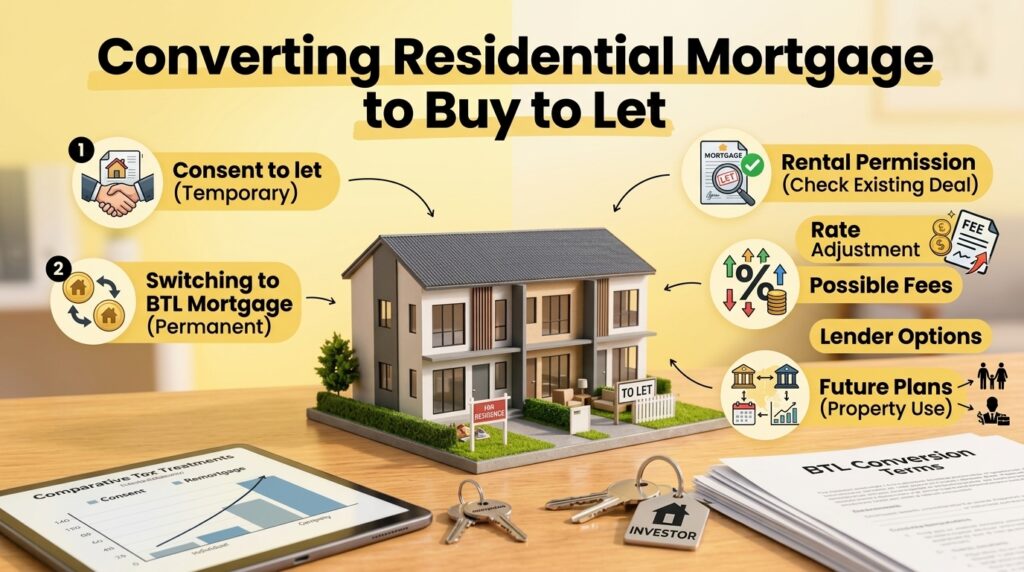
If you already own a home and want to rent it out instead of selling it, you can’t simply start letting it while still on a residential mortgage. Most residential mortgage agreements specifically prohibit letting the property without the lender’s permission.
There are two ways:
- Consent to let: Your existing lender allows you to rent the property out, usually temporarily, sometimes with a small fee or rate adjustment, without a full remortgage.
- Switching to a buy to let mortgage: A more permanent option, where you remortgage onto a proper buy to let deal, often with a different lender if your existing one doesn’t offer competitive buy to let rates.
Which way suits you depends on how long you plan to rent the property out for, and whether your current lender’s consent to let terms are competitive. It’s always worth checking before you assume you need to remortgage straight away.
Converting Mortgage to Buy to Let
Following on from consent to let, here’s the practical route through a full conversion.
- Check your current mortgage terms for any early repayment charges, which can make switching expensive if you’re still within a fixed period.
- Get the property valued, since your new loan-to-value will be based on current value, not what you originally paid.
- Confirm the rent it will achieve, ideally with more than one letting agent’s opinion, since this drives how much you can borrow.
- Apply for the new buy to let mortgage, treating it much like a fresh application, with the same rental income and stress testing rules covered earlier in this guide.
- Notify your existing lender once the new mortgage completes, so your old residential deal is properly closed.
Timing matters here. If you’re mid-way through a fixed rate, it’s often worth waiting until it ends, or checking whether the early repayment charge is smaller than the rate saving from switching sooner.
Can I Change My Mortgage to a Buy to Let
This is one of the most common questions landlords ask once they’ve seen the rules above, so it’s worth answering directly.
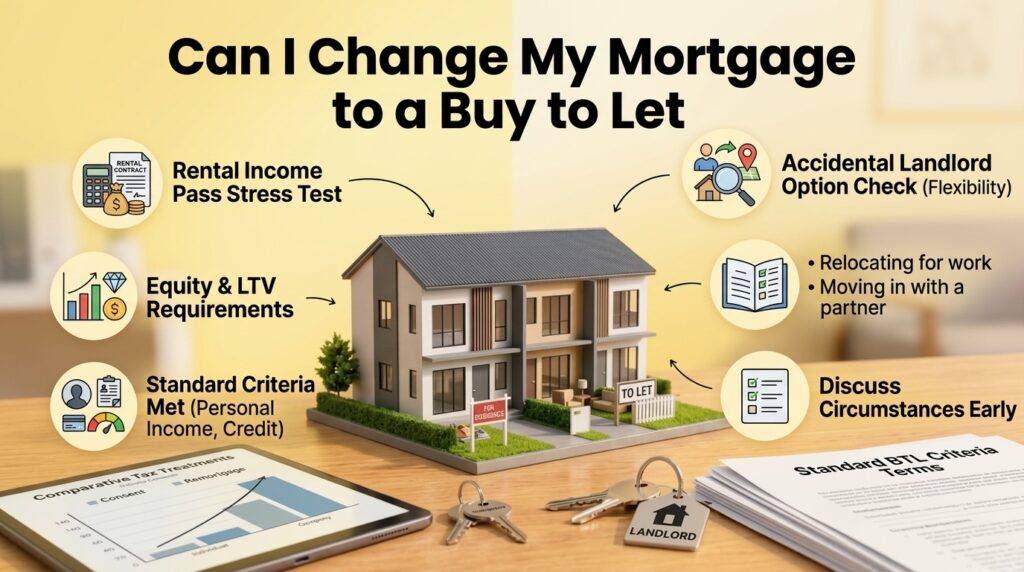
Yes, in most cases, provided:
- The rental income the property can achieve passes the lender’s stress test.
- You have enough equity in the property to meet the typical 75% loan-to-value requirement (or your lender’s specific threshold).
- Your personal circumstances, income and credit history meet the lender’s standard buy to let criteria.
Some lenders are more flexible than others about “accidental landlords”, people who didn’t plan to rent out a property but circumstances changed, such as moving in with a partner or relocating for work. If that’s your situation, it’s worth mentioning early, since it can open up options that a standard application wouldn’t.
Remortgage a Buy to Let Property
For landlords already on a buy to let mortgage, remortgaging when a fixed rate ends is one of the most important financial decisions in the whole ownership period, and it’s where a lot of the 2026 rule changes bite hardest.
A significant number of buy to let fixed rates taken out several years ago, when rates were much lower, are maturing now. Many landlords rolling off those older deals are finding their rental income no longer comfortably clears the stress test at today’s rates and today’s ICR requirements, even though nothing about the property or the tenant has changed.
If you’re approaching the end of a fixed rate:
- Start the process three to 6 months before your current deal ends, not after.
- Get an updated rental valuation, since rents have generally risen, which can help your ICR numbers.
- Compare products across the whole market, not just your existing lender’s switcher rates.
- Ask about top slicing if your rental income is close to the threshold but not quite clearing it.
Doing nothing isn’t a neutral option here. Letting a fixed rate lapse onto a lender’s standard variable rate is usually far more expensive than remortgaging in good time, even with today’s stricter rules factored in.
Buy to Let Mortgage Houses for Sale
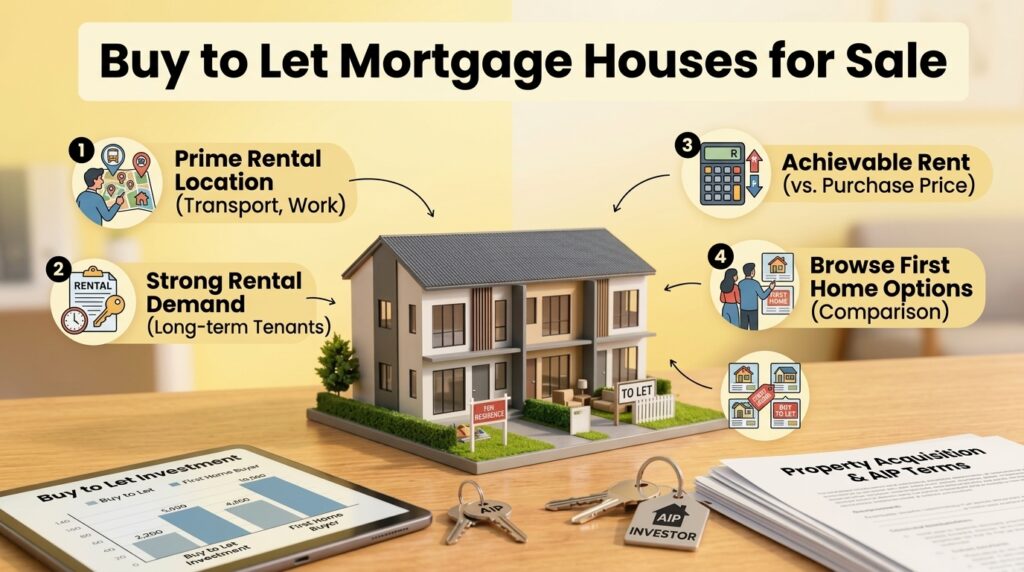
Once you’re clear on the rules, the rates, the deposit you’ll need and what you can realistically borrow, the last piece is finding a property that actually makes sense as a rental investment.
Good buy to let properties generally share a few traits: strong local rental demand, realistic achievable rent relative to purchase price, and a location where tenants want to stay for the longer term rather than move on quickly. Areas near transport links, universities, hospitals and employment hubs tend to hold up well for rental demand.
Worth noting: if you’re still weighing up buy to let against buying your first home, it’s a good idea to also browse houses for sale for first time buyers, since the numbers, deposit requirements and lending criteria work quite differently depending on which route you take, and it’s easier to compare properly before you commit to one path.
If you’re actively looking, it’s worth having your Agreement in Principle in place before you start viewing seriously. In a market where good rental properties can move quickly, being ready to make an offer with financing already lined up puts you ahead of buyers who are still working out their numbers.
Recap
Buy to let hasn’t become impossible, but it has become more of a numbers game than it used to be. Rental income, not personal salary, now sits at the centre of almost every lending decision, and the stress testing behind it has genuinely tightened.
To recap the essentials:
- Rental income needs to clear a stress-tested Interest Coverage Ratio, typically 125% to 145% depending on your tax position.
- Deposits usually start at 25%.
- Limited company borrowing works differently, and often more favourably, for higher-rate taxpayers.
- Remortgaging in good time matters more than ever, since many older deals no longer pass today’s tests.
- Rates and criteria vary significantly between lenders, so comparing properly is worth the time it takes.
If you’re weighing up a new purchase, a remortgage, or converting an existing property into a rental, it’s worth getting your numbers checked against current lender criteria before you commit to anything. Get in touch with BM14 Finance and we’ll go through your situation and what today’s rules actually mean for you.