

Last updated: 28 August 2026 · 12–15 min read
Whether you are buying your first home, moving to a bigger property, or planning to remortgage before your current deal ends, understanding how mortgage rates work in 2026 is one of the most important financial decisions you will make this year.
Rates have changed significantly over the past few years, and many buyers are still confused about what to expect, which type of mortgages suits them best, and whether now is actually a good time to act.
This guide breaks everything down in an easy way, no jargon, no fluff, so you can make a confident, well-informed decision, and, if you’re ready, get matched with the right lender and rate for your situation.
Jump to: Current Rates · Best Rates · Our Services · Our Application Process · FAQs
Ready to see what rate you’d actually qualify for? Request a free appointment with BM14 Finance
What are Nationwide Mortgage Rates and Who Sets Them?

When people search for “nationwide mortgage rates UK,” they are usually asking one thing: what rates are lenders offering across the country right now. This guide covers a general, whole-of-market view of UK mortgage pricing, so you can compare your options before deciding on a lender or product.
These rates are not decided by one organisation. Instead, they are shaped by a combination of factors:
-
- The Bank of England base rate is the single biggest influence on what lenders charge.
-
- Inflation figures: When inflation is high, lenders price risk into their rates.
-
- Swap rates: The cost at which banks borrow money from each other in financial markets.
-
- Competition between lenders: Banks and building societies compete for customers, which can push rates down.
-
- Your personal financial profile: Your deposit size, credit history, and income all affect the rate you personally receive.
In simple terms, when the economy is under pressure, mortgage rates go up. When things stabilise, rates tend to ease. Right now in 2026, we are in a period where rates remain elevated but are slowly becoming more predictable.
Looking for a whole-of-market comparison rather than a single lender’s rate? Talk to a BM14 Finance adviser, we compare deals across the full market, not just one bank.
Our Mortgage Services
At BM14 Finance, we help clients across every stage of the property journey, not just one type of borrower. Whether you’re buying your first home, moving up the property ladder, remortgaging an existing deal, or investing in a rental property, we compare options across the whole market to find what actually fits your situation.
Buy-to-Let: Advice for landlords and property investors, including rental income assessment and specialist lender access.026, we are in a period where rates remain elevated but are slowly becoming more predictable.
First-Time Buyers: Guidance from your first mortgage in principle through to completion, including advice on deposit size, government schemes, and lender eligibility and the full range of first time buyer benefits available to you.
Home Movers: Support with porting your existing mortgage, securing a new deal, and managing the timing between selling and buying.
Remortgaging: Help finding a better rate before your current deal expires, so you avoid rolling onto your lender’s SVR.
Not sure which service fits your situation?
See everything BM14 Finance offers- first-time buyers, home mover, remortgage or buy to let in one place.
Current Nationwide Mortgage Rates
Mortgage rates across the UK have stayed relatively steady through August 2026, though the picture depends heavily on which type of deal you’re looking at. The Bank of England base rate has held at 3.75% since December 2025, with the next review due on 17 September 2026 and that decision is expected to have a knock-on effect on fixed and tracker pricing over the coming months.
On the fixed-rate side, the average two-year fixed mortgage rate currently sits at around 5.59%, while the average five-year fixed rate is close to 5.63%. Standard variable rate (SVR) mortgages, the default rate borrowers roll onto once a fixed deal ends, remain considerably higher, averaging 7.13%, although this varies significantly between lenders.
Deposit size still plays a major role in what rate you’re offered. Borrowers with a larger deposit (lower loan-to-value) consistently access cheaper pricing than the headline averages suggest, with two-year fixed rates at 60% LTV averaging closer to 4.67%.
UK Average Mortgage Rates – August 2026
| Mortgage Type | Average Rate |
| 2-Year Fixed (overall average) | ~5.59% |
| 5-Year Fixed (overall average) | ~5.63% |
| 2-Year Fixed (60% LTV) | ~4.67% |
| 2-Year Variable/Tracker | ~4.51% |
| Standard Variable Rate (SVR) | ~7.13% |
| Bank of England Base Rate | 3.75% |
Figures are UK market averages and will vary by lender, deposit size, and individual circumstances, always confirm current rates before committing to a deal.
Wondering what these rates mean for your monthly payment?
Add in your numbers and see a real repayment estimate in seconds.
Best Nationwide Mortgage Rates
While averages give a useful benchmark, the best available rates in the market are noticeably lower, particularly for borrowers with a strong deposit and clean credit profile. As of August 2026, the lowest two-year fixed rate on the market is around 4.32–4.33%, available at 60% LTV, while the best five-year fixed deals are pricing at roughly 4.48%.
Overall, residential mortgage rates across the UK currently span a wide range, from around 3.9% at the cheapest end to over 6% for higher-LTV or more complex income cases, which shows just how much a borrower’s deposit and financial profile can shift the rate they’re offered.
A lower loan-to-value ratio and a stronger credit profile generally unlock more competitive pricing, so two applicants with different deposits can end up with very different offers even on the same property.
Best Available UK Mortgage Rates – August 2026
| Deal Type | Best Rate Available | Typical Requirement |
| Best 2-Year Fixed | ~4.32% | 60% LTV |
| Best 5-Year Fixed | ~4.48% | 60% LTV |
| Overall Market Range | 3.9% – 6.4%+ | Varies by LTV/circumstances |
The “best” rate advertised isn’t guaranteed for every borrower, eligibility depends on deposit, credit history, income, and the lender’s individual criteria.
Want to know which of today’s best rates you’d actually qualify for? As a whole-of-market broker, BM14 Finance compares deals across mainstream and specialist lenders, including options not listed on comparison sites. Book a free appointment
Why Are UK Mortgage Rates Still High in 2026?
Many buyers feel frustrated because rates are considerably higher than they were in 2020 and 2021. Here is what happened:
2020–2022: The Bank of England kept its base rate at historically low levels (as low as 0.1%) to support the economy during the pandemic. Fixed mortgage rates fell to record lows, and some buyers locked in deals below 2%.
2022–2023: Inflation surged across the UK, peaking above 11%. To bring inflation down, the Bank of England raised its base rate rapidly from 0.1% all the way to 5.25%, the highest level in over 15 years.
2024–2026: Inflation has gradually come down toward the 2% target, and the Bank of England has made some cautious reductions to the base rate. However, rates have not returned to pandemic lows and are unlikely to do so in the near future.
For buyers and homeowners in 2026, this means:
-
- Ultra low rates below 2% are gone for now.
-
- Current fixed rates in the 5% range are actually closer to the historical average than the 2020 exception.
-
- Rates are expected to ease slowly, but no one can predict exactly when or by how much.
Types of Mortgage Rates Explained
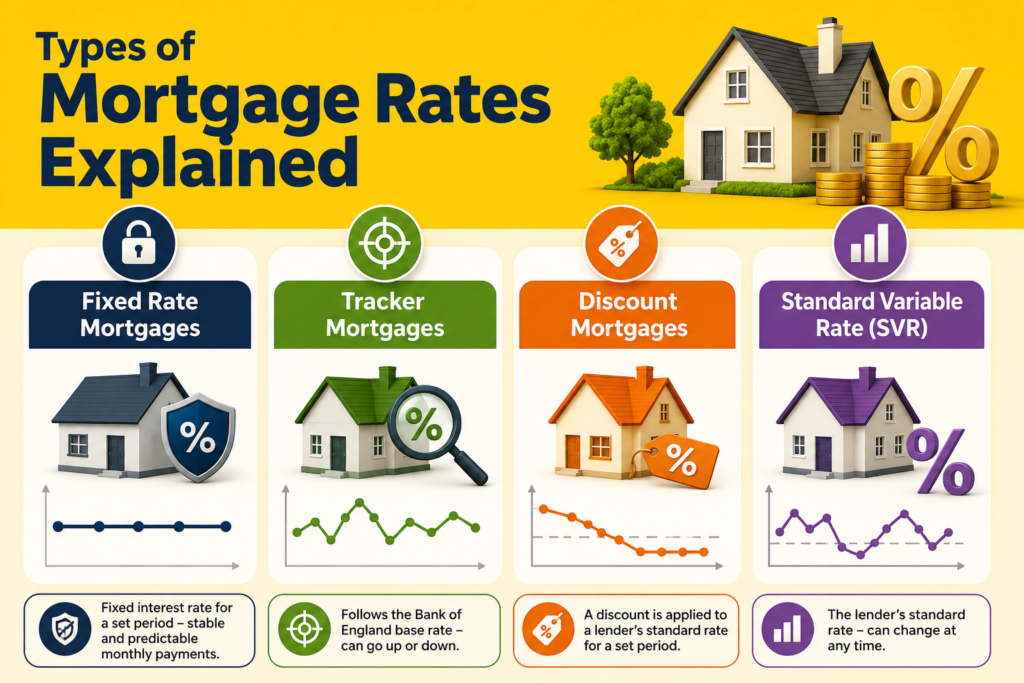
Understanding the difference between mortgage types is essential before you apply. Each one works differently, and choosing the wrong one for your situation can cost you thousands of pounds over your mortgage term.
Fixed Rate Mortgages
A fixed rate mortgage locks your interest rate for a set period, usually 2, 5, or 10 years. During this time, your monthly repayment stays exactly the same, regardless of what happens to the Bank of England base rate.
Best for: People who want certainty and predictability in their monthly budget, especially first-time buyers managing finances for the first time.
2-Year Fixed: Lower initial rate, but you will need to remortgage sooner, which means more arrangement fees over time and exposure to whatever rates look like in 2 years.
5-Year Fixed: Slightly higher rate than a 2-year deal in some cases, but gives you 5 years of stability. Many buyers prefer this because it reduces the stress of constantly shopping around.
10-Year Fixed: Best for those who want long-term certainty. However, be careful, early repayment charges (ERCs) on 10-year deals can be significant if your circumstances change.
Key disadvantage: If market rates fall during your fixed term, you will not benefit, you are locked in at your agreed rate.
Nationwide Mortgage Tracker
A nationwide mortgage tracker follows the Bank of England base rate, usually at a set margin above it. For example, if the base rate is 3.75% and your tracker is “base rate + 0.9%”, you would pay 4.65%.
When the base rate goes down, your payments automatically decrease. When it goes up, so does your monthly payment.
Best for: Buyers who believe rates will fall in the near future and want to benefit from reductions without the cost of remortgaging.
Key risk: If the Bank of England raises rates unexpectedly, your monthly payment increases, sometimes with little warning. You need to be financially resilient enough to absorb potential increases.
Important: Some tracker mortgages come with a “collar”, a minimum rate below which your rate will not fall, even if the base rate drops significantly. Always check for this before signing.
Discount Mortgages
A discount mortgage offers a reduction below the lender’s SVR for a set period. For example, “SVR minus 1.5%”, so if the SVR is 7%, you would pay 5.5%.
Unlike trackers, discount mortgages move with the lender’s own SVR, which the lender can change at any time, even without the Bank of England moving. This makes them slightly less predictable than trackers.
Standard Variable Rate (SVR)
The SVR is the default rate your mortgage reverts to once your fixed, tracker, or discount deal expires. Most lenders set their SVR between 6.5% and 7.5%, significantly higher than available deal rates.
The golden rule: Never sit on an SVR for longer than necessary. As soon as your current deal ends, start exploring remortgage options. Even if rates feel high, the SVR is almost always worse.
Fixed vs Tracker: Which Should You Choose in 2026?
This is the question most buyers ask, and the honest answer is: it depends on your personal situation.
| Factor | Fixed Rate | Tracker Rate |
| Monthly payments | Completely stable | Can rise or fall |
| Risk level | Low | Medium |
| Best if rates fall | No, you miss savings | Yes, payments drop |
| Best if rates rise | Yes, you are protected | No, payments increase |
| Suited to | Budget-conscious buyers | Risk-tolerant buyers |
| Early repayment charges | Usually yes | Often lower or none |
Our general view for 2026: Given that rates are still uncertain and the Bank of England is making gradual reductions, a 5-year fixed deal offers a good balance of stability and reasonable rates for most buyers. However, if you believe rates will fall meaningfully in the next 12 to 18 months and you can absorb payment fluctuations, a tracker could save you money.
Always talk to a qualified specialist mortgage broker before deciding, what works for one buyer may not work for another.
Still torn between fixed and tracker?
Tell us your situation and we’ll tell you which one actually suits it.
How BM14 Finance’s Mortgage Application Process Works
Once you’ve got a sense of where rates stand, the next question is: what does actually applying involve, and how long does it take? Here’s exactly how we work with clients from first enquiry to keys in hand.
We ensure that your application process is efficient and seamless. We start by understanding your requirements, checking your eligibility, and presenting the best available options. We then obtain an “Agreement in Principle” (AIP) from the lender. This sets out the terms of your mortgage rate, repayment terms, and more. Thereafter, it’s a simple case of finalising the paperwork and getting you ready for your new home. The entire process can take as little as 6 weeks.
What Documents Do You Need?
To get started, we need:
-
- A copy of your ID (driving licence or passport)
-
- Proof of funds for your deposit (e.g. bank statements)
-
- Proof of income (e.g. payslips, tax returns)
These basic documents enable us to perform an affordability check and the required KYC (know-your-client) checks. Different lenders may request additional documents on a case-by-case basis, depending on your circumstances.
How Long Does the Mortgage Application Process Usually Take?
At BM 14 Finance, the process can take as little as 4 to 6 weeks. It is largely driven by how quickly you’re able to provide the required documents, the faster we receive everything, the faster we can move your application forward.
Ready to get started? Getting your documents together now means we can begin your eligibility check straight away. Request an appointment with BM14 Finance
Ready to get started?
Getting your documents together now means we can begin your eligibility check straight away.
What Actually Determines the Rate You Get?
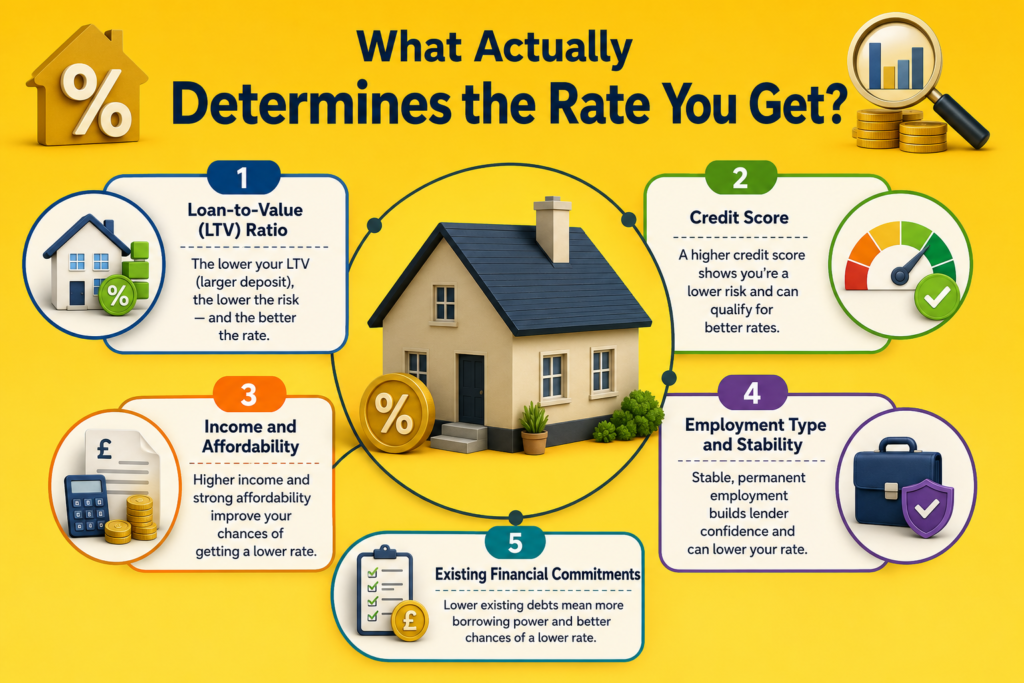
Two people applying for a mortgage on the same day can receive very different rates. Here is what lenders look at:
1. Loan-to-Value (LTV) Ratio
Your LTV is the percentage of the property value you need to borrow. A lower LTV means less risk for the lender and typically a better rate for you.
| Deposit Size | LTV | Rate Tier |
| 5% deposit | 95% LTV | Highest rates |
| 10% deposit | 90% LTV | Moderate rates |
| 15–20% deposit | 80–85% LTV | Better rates |
| 25%+ deposit | 75% LTV or below | Most competitive rates |
Example: On a £250,000 property, a 10% deposit (£25,000) gives you a 90% LTV. A 25% deposit (£62,500) gives you a 75% LTV, which could reduce your rate by 0.5% to 1%, saving you thousands over your mortgage term.
2. Credit Score
Your credit score tells lenders how reliably you have managed debt in the past. A strong credit score can unlock better rates. A poor credit history may mean fewer lender options and higher rates, or in some cases, mortgage decline.
Quick wins to improve your credit score:
-
- Register on the electoral roll at your current address.
-
- Pay all bills and existing debt on time.
-
- Reduce credit card balances to below 30% of your limit.
-
- Avoid applying for new credit in the 3 to 6 months leading up to the mortgage application process.
-
- Check your credit report for errors (Experian, Equifax, and TransUnion all offer free access).
3. Income and Affordability
Lenders usually lend between 4x and 4.5x your annual income. Some specialist lenders will go up to 5x or 5.5x for certain professions or high earners. Both employed and self-employed applicants (mortgage for self employed) can qualify, though self employed buyers usually need at least 2–3 years of accounts.
4. Employment Type and Stability
Permanent employment is viewed most favourably. Contract workers, freelancers, and self-employed buyers are not excluded, but lenders assess them differently. Some lenders specialise in non-standard employment, a whole of market broker can identify these for you.
5. Existing Financial Commitments
Car finance, credit card debt, personal loans, and even student loan repayments all affect how much a lender will offer you. The more committed your income already is, the less a lender will advance.
Cost Examples: How Much Does 1% Really Matter?
Many buyers underestimate how much a small rate difference changes their actual costs. Here are some real examples:
Borrowing £200,000 over 25 years:
| Interest Rate | Monthly Payment | Total Repaid Over 25 Years |
| 4.50% | £1,111 | £333,300 |
| 5.00% | £1,169 | £350,700 |
| 5.50% | £1,228 | £368,400 |
| 6.00% | £1,289 | £386,700 |
| 6.50% | £1,351 | £405,300 |
The difference between 4.5% and 6.5% on a £200,000 mortgage: Over £72,000 in total interest paid. That is why securing the right rate matters enormously, even a 0.5% improvement can save you well over £10,000 across a 25-year term.
Borrowing £350,000 over 25 years:
| Interest Rate | Monthly Payment |
| 5.00% | £2,046 |
| 5.50% | £2,149 |
| 6.00% | £2,255 |
On a larger mortgage, the gap widens further, every percentage point matters more.
First Direct Loan Calculator
If you landed here looking for a loan calculator, you’re probably just trying to work out what your monthly repayments would look like before committing to anything, you don’t need to hunt down a separate calculator for every lender.
BM14 Finance’s own mortgage calculator does this in one place: a mortgage calculator to estimate monthly repayments based on your loan amount, term and rate, plus a rental mortgage calculator built specifically for landlords working out buy-to-let affordability. Both are free, take a couple of minutes, and give you an actual starting figure before you talk to an adviser.
See what 1% actually costs on YOUR mortgage
Enter your loan amount and compare rates side by side.
First-Time Buyers: What You Need to Know in 2026
If this is your first mortgage, the process feels overwhelming. Here is a simple overview of what to expect:
Step 1: Check what you can afford. Work out your total monthly budget. Remember to factor in not just the mortgage but also council tax, utility bills, insurance, and maintenance costs.
Step 2: Save your deposit. Most first time buyer mortgages need a minimum of 5% deposit. A 10% deposit opens more lender options and better rates. A 15–20% deposit gives you access to the most competitive deals.
Step 3: Get a mortgage in principle (MIP). Before you start viewing properties seriously, speak to a lender or broker and get a mortgage in principle. This is a conditional agreement showing how much you could borrow, estate agents and sellers take you more seriously with one in hand.
Step 4: Find your property and apply. Once you have an offer accepted, your broker or lender will formally process your mortgage application, following the step-by-step process outlined above. This typically involves a property valuation and full affordability assessment.
Step 5: Exchange and complete. Once all checks pass, you exchange contracts (legally committing to the purchase) and set a completion date, when you receive the keys.
First time navigating this? Book a free first-time buyer consultation with BM14 Finance , we’ll walk you through every step, from your Agreement in Principle to completion.
Nationwide Helping Hand Mortgage
Nationwide’s Helping Hand is built for first-time buyers who can afford the monthly payments but fall short under normal income multiples. It lets eligible buyers borrow up to 6 times their income, well above the usual 4 to 4.5 times, on a 5 or 10-year fixed rate, up to 95% LTV. To qualify, you (or the higher earner on a joint application) typically need to earn at least £30,000 alone or £50,000 jointly.
It’s a real option for buyers priced out by standard affordability rules, but it’s not automatically the cheapest or the right fit for everyone, longer fixed terms mean less flexibility later. This is where BM14 Finance helps: we check whether you meet Helping Hand’s criteria and weigh it against other high-multiple or low-deposit options, so you don’t end up in a deal that doesn’t suit you.
Buying your first home?
See our dedicated first-time buyer support, from enquiry to completion.
5k Deposit Mortgage Scheme UK
A number of UK lenders now let first-time buyers get on the ladder with just £5,000 saved, regardless of the property price, instead of the usual 5% deposit. On a £250,000 home, a standard 5% deposit is £12,500; under a £5k deposit scheme, you’d only need £5,000, with the lender covering the rest up to around 98–99% loan-to-value.
These deals are usually five-year fixed, capped at properties up to roughly £300,000–£500,000 depending on the lender, and open only to first-time buyers who pass standard affordability and credit checks. They can shorten your time to homeownership considerably, but the trade-off is a higher rate than you’d get with a bigger deposit. BM14 Finance checks if you qualify and shows you how it stacks up against Nationwide’s Helping Hand or a standard 5% deposit deal
Remortgaging in 2026: Do Not Leave It Too Late
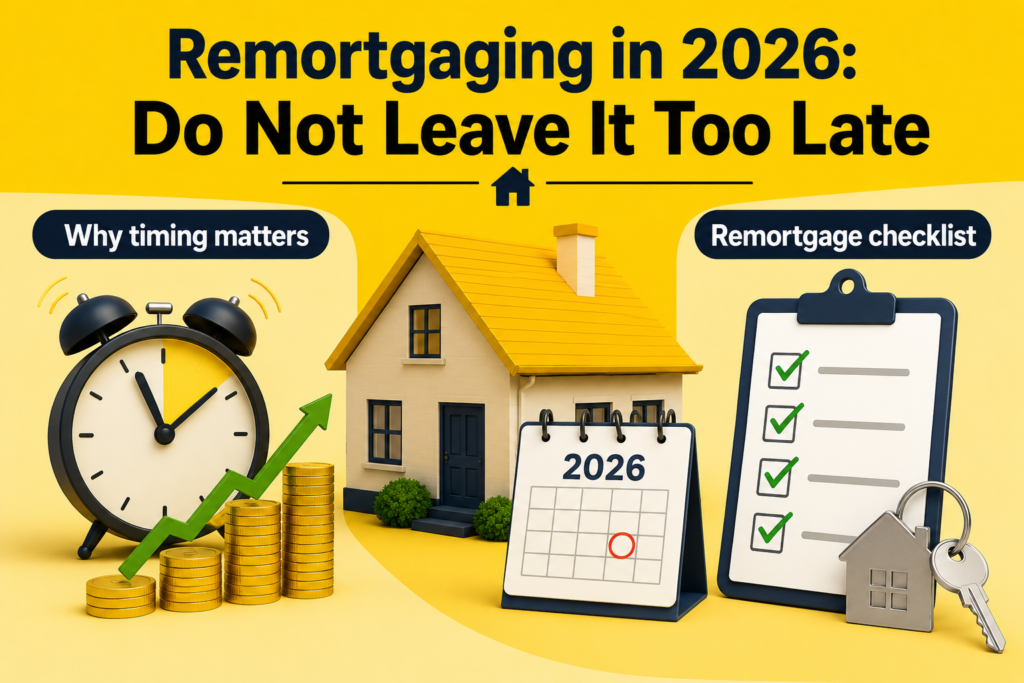
If your current fixed deal is ending in the next 3–6 months, remortgaging should be at the top of your financial to-do list.
Do you know how does remortgaging work? If not, no worries, this guide definitely helps you.
Why timing matters:
Most lenders allow you to lock in a new rate up to 6 months before your current deal ends. This means you can secure a rate now without it taking effect until your current deal expires, so you benefit from today’s rates with no penalty.
If you wait and slip onto your lender’s SVR, you could be paying 6.5% to 7%+ instead of a fixed rate in the 5% range. On a £200,000 mortgage, that difference can be £200 or more per month.
Remortgage checklist:
-
- Check your current deal end date and any early repayment charges.
-
- Start comparing rates at least 6 months before your deal expires.
-
- Consider whether to fix again or explore tracker options.
-
- Check whether your home has increased in value, a better LTV ratio may qualify you for a lower rate.
-
- Use a whole of market broker to access deals not available directly.
Deal ending soon? Start your remortgage review with BM14 Finance , we’ll check your available options up to 6 months ahead with your consent.
Deal ending in the next few months?
Contact BM14 Finance, we will discuss more available deal options with you.
Buy to Let Mortgage Rates in 2026
Buy-to-let mortgages work differently from residential mortgages and typically come with higher rates.
Key differences:
-
- Most buy-to-let mortgages require a minimum 25% deposit (75% LTV).
-
- Lenders assess rental income as well as personal income, typically requiring rental income to cover 125–145% of the mortgage payment.
-
- Buy-to-let mortgage rates currently range from approximately 5.5% to 6.5% for standard products.
-
- Arrangement fees tend to be higher than residential mortgages.
-
- Interest-only buy-to-let mortgages are common and widely available.
Important: Buy-to-let mortgage interest is no longer fully tax-deductible for most landlords. Tax rules in this area are complex, always speak to both a mortgage adviser and a tax specialist before purchasing an investment property.
Investing in a rental property?
Get specialist buy-to-let advice, including rental income assessment and lender access.
Nationwide Buy to Let Mortgage Rates
If you’re specifically comparing Nationwide for a buy-to-let purchase, note that its BTL lending runs through The Mortgage Works, Nationwide’s specialist buy-to-let arm, not its standard residential range. As of September 2026, 5-year fixed BTL rates start from around 4.09%, with a £1,495 arrangement fee, though the exact figure depends on your rental income cover and portfolio size.
Before locking into one lender’s buy-to-let range, it’s worth checking it against the rest of the market. BM14 Finance compares Nationwide’s BTL deals alongside other specialist lenders, so you get a rate that actually matches your rental numbers, not just the headline figure
Is Now a Good Time to Get a Mortgage?
This is the question everyone asks, and the honest answer is: there is no perfect time, only the right time for your situation.
Arguments for acting now:
-
- Rates have stabilised and are no longer rising sharply.
-
- Waiting for rates to fall means also waiting to buy, and property prices may rise in the meantime.
-
- You can lock in a deal today, with some lenders allowing a 6-month rate hold.
-
- Certainty has value, knowing your payments for the next 5 years enables proper financial planning.
Arguments for waiting:
-
- Some economists expect the Bank of England to cut rates further in late 2026 and into 2027.
-
- If rates fall by 0.5% or more, you could save a meaningful amount.
-
- However, you would need to correctly time both the rate drop and the property market.
The practical approach most advisers recommend: If you can afford the current payments comfortably and you are ready to buy or remortgage, don’t wait for the “perfect” rate that may never come. Focus on what you can control, your deposit, your credit score, and your lender selection.
How to Get the Best Mortgage Rate: Practical Steps?
Here is a clear action plan to maximise your chances of securing a competitive rate:
-
- Check and improve your credit score: at least 3–6 months before applying, review your report and fix any errors or issues.
-
- Save the largest deposit you can: even going from 10% to 15% can unlock a meaningfully better rate.
-
- Avoid taking on new debt: new credit agreements in the months before a mortgage application can reduce what lenders will offer.
-
- Get your documents together: ID, payslips, bank statements, and proof of address speed up the process considerably (see the documents checklist above).
-
- Use a whole-of-market broker: they search hundreds of deals, including some not available on comparison sites.
-
- Consider all costs, not just the rate: arrangement fees, valuation fees, and legal costs all affect the true cost of your mortgage.
-
- Understand early repayment charges: especially important if your circumstances might change before your fixed term ends.
Want a broker to do the searching for you? Book your free eligibility check with BM14 Finance
Ready to put this into action?
Whichever stage you’re at, buying, moving, remortgaging or investing, BM14 Finance can help.
Summary: Key Takeaways for 2026
-
- UK mortgage rates remain elevated in 2026 but have stabilised. The era of sharp rises appears to be over.
-
- 2-year and 5-year fixed rates average around 5.6%, with the best deals available from roughly 4.3% for well-qualified borrowers.
-
- Your deposit size and credit score have the biggest impact on the rate you personally receive.
-
- The SVR is almost always the most expensive option, never sit on it longer than necessary.
-
- Getting your documents ready in advance (ID, proof of income, proof of deposit) can get your application moving in as little as 4–6 weeks.
-
- A whole-of-market mortgage adviser can access better deals and save you significant money over your mortgage term.
NOTE: The information in this guide is for educational purposes and reflects general market conditions. First-time mortgage rates and other deals change regularly. Always contact a specialist mortgage broker for personalised advice before making a financial decision.
Ready to find your rate? Request an appointment with BM14 Finance , tell us your requirements and we’ll compare deals from across the whole market on your behalf.
Frequently Asked Questions
What is the average UK mortgage rate today?
As of August 2026, average fixed mortgage rates across UK lenders sit around 5.59% (2-year fixed) and 5.63% (5-year fixed), with the lowest headline rates (around 4.3%–4.5%) typically reserved for borrowers with a 40% deposit or more. Your personal rate depends heavily on your own deposit and circumstances.
Are UK mortgage rates dropping?
Yes, gradually. Several major lenders made further cuts to their fixed mortgage rates in August 2026, with reductions of up to 0.15–0.19 percentage points seen across 2, 3 and 5-year fixed products for first-time buyers, home movers and remortgage customers. The trend has been downward through 2026, though cuts have been modest rather than dramatic.
Will mortgage rates ever be 3% again?
Not in the near future, based on current forecasts. The Bank of England held its base rate at 3.75% in July 2026, and the Bank’s own market-implied projections point to the base rate settling somewhere between 3.25% and 4.25% by the end of the decade — well above the near-zero levels seen through much of the 2010s. A return to widespread 3% mortgage deals would need a much larger and more sustained fall in the base rate than is currently expected.
Can I get a 25 year mortgage at 55?
It’s possible, but it depends on the lender’s maximum age limit at the end of the mortgage term. Most mainstream lenders cap this somewhere between 70 and 80, so a 25-year term starting at age 55 would run until you’re 80, which some lenders accept and others won’t. Approval also depends on your retirement income, pension provisions, and overall affordability. Discuss your specific situation with BM14 Finance to find a lender whose age criteria and terms fit your plans.
Have UK mortgage rates fallen below 5%?
Yes, for many borrowers. Fixed rates below 5% are now available across a number of UK lenders, with the lowest headline deals sitting around 4.3%–4.5% on 2-year fixes for borrowers with a larger deposit (60% LTV or lower). That said, rates above 5% remain common at higher loan-to-value bands or for borrowers with smaller deposits, so whether your own rate falls below 5% depends on your deposit size and circumstances. BM14 Finance can check the current below-5% deals you’d actually qualify for.
What information do you collect from clients during the mortgage application process?
To start your application, BM14 Finance asks for a copy of your ID (driving licence or passport), proof of funds for your deposit (such as bank statements), and proof of income (such as payslips or tax returns). These documents let us carry out an affordability check and the required KYC (know-your-client) process. Get in touch and we’ll confirm exactly what’s needed for your situation.
How long does the mortgage application process usually take?
At BM14 Finance, the process can take as little as 4 to 6 weeks, largely driven by how quickly you’re able to provide the required documents. The sooner your paperwork is in, the sooner we can move things forward.
What is a mortgage rate calculator?
A mortgage rate calculator lets you estimate monthly repayments by entering your loan amount, deposit, term, and chosen fixed or variable rate. That said, calculators only give a general estimate, since your actual rate depends on your LTV, credit profile, and product fees. For a personalised figure based on your full circumstances, BM14 Finance run the calculation and matches you to suitable mortgage products.
Will UK mortgage rates go down in 2026?
Some further reductions are expected as inflation continues to ease and the Bank of England gradually lowers its base rate. However, the pace and scale of reductions remain uncertain. Most forecasters expect rates to ease slowly rather than fall sharply.
How much deposit do I need?
The absolute minimum is 5% of the property purchase price. However, a 10% deposit significantly opens your options, and a 15–25% deposit gives you access to the most competitive rates.
What happens when my fixed rate mortgage ends?
Your mortgage automatically moves to your lender’s Standard Variable Rate (SVR), which is usually significantly higher. Start looking at remortgage options 3 to 6 months before your current deal expires to avoid paying more than necessary.
Should I use a mortgage broker or go directly to a bank?
Going directly to one bank means you only see that bank’s own products — not the whole market. The right first step is to talk to a broker: you share your requirements (income, property type, goals, how much you want to borrow), and the broker sources and compares deals for you from dozens of lenders, including some products that are only available through intermediaries and not to the public directly. This is exactly what BM14 Finance does — you share your requirements with us, and we source and manage the deals for you. Request an appointment →
Can I overpay my mortgage?
Most mortgage deals allow you to overpay by up to 10% of your outstanding balance per year without penalty. Overpaying can significantly reduce the total interest you pay and shorten your mortgage term.interest you pay and shorten your mortgage term.