

You are not really choosing between two policies. You are choosing which bad day your family can afford: the day you die, or the day you survive something serious and cannot work.
Here is critical illness insurance vs life insurance in one line. Life insurance pays your family if you die. Critical illness insurance pays you a lump sum if a doctor diagnoses a serious illness your policy lists and you live through the survival period, usually 10 to 14 days.
Most people only plan for the first one. The second one hits your bank account first. If you are employed, Statutory Sick Pay is £123.25 a week from April 2026, or 80% of your earnings if that is lower. If you are self-employed, you get no Statutory Sick Pay at all. Try paying a mortgage on that.
This guide shows you how to work out which cover you need first, what changed in the UK this year, what is coming in 2027, and which parts of the policy catch people out. If you would rather talk it through, a protection advisor at BM14 Finance can compare cover for you.
Critical Illness Insurance vs Life Insurance
Life insurance protects the people who depend on you if you die. Critical illness insurance protects the household if you live but cannot earn. Neither one replaces the other, and buying the wrong one first is the most common protection mistake.
Difference Between Life Insurance and Critical Illness Cover
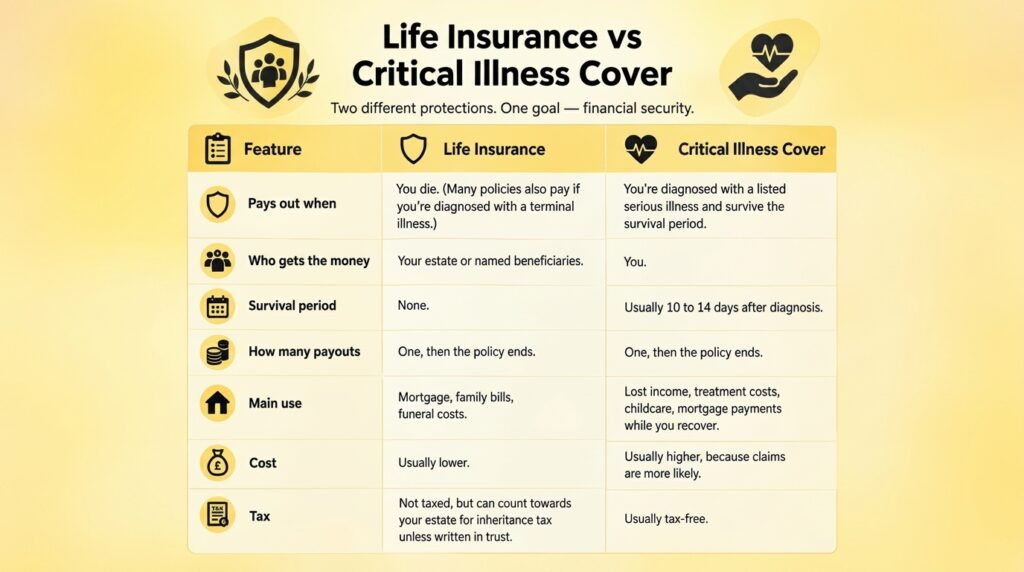
| Life insurance | Critical illness insurance | |
| Pays out when | You die, or doctors say you have under 12 months to live | A doctor diagnoses (or you have surgery for) a condition your policy lists, and you live past the survival period |
| Who gets the money | Your family or named beneficiaries | You |
| What it protects | Mortgage, debts and your family’s living costs | Your income and bills while you recover |
| Price | Lower | Higher, because claims are more likely during the term |
| After a full claim | The policy ends | The policy ends |
| Main trap | Wrong or incomplete health answers | Assuming any serious illness pays. The policy wording decides |
That last row matters more than any other. Life insurance pays on a fact: you died. Critical illness cover pays on a definition. A diagnosis that sounds serious to you can still fall short of the policy’s, such as an early-stage cancer or a stroke with a quick recovery.
Count four things before you buy either:
- Savings: how many months of spending they cover.
- Employer sick pay: how long you get full pay, and what happens after. Statutory Sick Pay is the floor, not a plan.
- Death in service: the multiple of your salary your employer pays if you die. It usually ends when you leave the job.
- Your partner’s income: whether it could carry the household for a year on its own.
What is left after those four is the gap you are insuring. Basically, life insurance fills the gap that opens if you die. Critical illness cover fills the gap that opens if you survive a serious diagnosis.
Which One Should You Buy First? Two Example Households
These are illustrative round numbers, before tax. They show the method, not a quote.
A couple with two children and a repayment mortgage. Sam earns £45,000 and Imogen earns £32,000. They owe £240,000, have £15,000 in savings, and Sam’s employer pays death in service of twice his salary (£90,000).
- Life cover need: £240,000 mortgage + £60,000 for childcare and a few years of lost income = £300,000. Take away savings and death in service (£105,000) and the gap is £195,000.
- Illness gap: if Sam’s employer pays full salary for three months (£11,250) and nothing after, a year off work leaves £33,750 uncovered. A critical illness sum of about £50,000 covers that and chips into the mortgage.
- Order: life cover first, because two children depend on the income. Critical illness cover second, sized to the gap and not to the whole mortgage.
A self-employed tradesperson, 34, renting, no dependants. Profit is about £38,000 a year, savings are £8,000, and there is no employer sick pay and no Statutory Sick Pay.
- Life cover need: small. Funeral costs and any debts.
- Illness gap: 12 months off work puts £38,000 at risk. After savings, £30,000 is uncovered.
- Order: the illness gap comes first here. Compare critical illness cover with income protection, which pays a monthly income and is not tied to a list of conditions. Back problems and mental health conditions often fall outside a critical illness list.
Your real numbers will differ. A protection advisor builds the figure from your actual mortgage, income and employer benefits.
What types of insurance should you consider if you live in the UK?
In the UK, motor insurance is the main cover the law requires if you drive. Beyond that, most people should think about life insurance, critical illness cover, income protection and buildings and contents insurance. Which ones you need depends on your family, your mortgage and how long you could manage without your income.
In more detail
Cover | What it does | Consider it if… |
Motor insurance | Legal requirement if you drive | You own or drive a vehicle |
Life insurance | Pays your family a lump sum, or a monthly income, if you die | Someone depends on your income, or you have a mortgage |
Critical illness cover | Pays you a tax-free lump sum if you are diagnosed with an illness on the policy list | You could not cope financially if you were seriously ill |
Income protection | Pays a monthly income if illness or injury stops you working | You rely on your pay and have little sick pay or savings |
Buildings and contents insurance | Pays for damage to your home and your belongings | You own your home (lenders usually ask for buildings cover) or have belongings to protect |
Whole of life and over 50s cover | Pays out whenever you die, as long as you keep paying | You want to leave money for funeral costs or your family |
A simple way to start is to ask: what could I not afford to pay for if something went wrong? Begin with the people and the income that depend on you, then add cover for your home and your belongings.
Visit us for a one on one discussion
If you live near London or Hempstead, Kent, you can meet a BM14 Finance adviser at one of our offices for a one on one discussion about which cover suits you. Our London office is at Berkeley Square House, Mayfair, and our second office is in Hempstead, Kent (ME7). Please book an appointment first so an adviser is ready for you, or call +44 789 567 7705.
What Has Changed in the UK This Year, and What is Coming Next
Most guides skip this part, but these dates change how big your protection gap is. Here is what matters for anyone buying life insurance or critical illness cover right now.
Date | What happened or is due | What it means for your cover |
6 April 2026 | Statutory Sick Pay now starts on day one. It pays the lower of £123.25 a week or 80% of your normal earnings, for up to 28 weeks | Better than before, but 28 weeks at £123.25 is £3,451 at most. Set that against your own monthly mortgage payment |
21 September 2026 | The FCA published its final protection market study. 58% of adults hold no protection, and 59% of them have never considered their needs. It found claims acceptance is high and no market-wide harm | The problem is not that insurers refuse to pay. It is that people never buy. It also flagged delays in getting medical information, so have your GP details ready |
26 October 2026 | Legal & General launched standalone critical illness cover, so advisers can recommend it separately from life cover | If you already have life insurance, you can look at adding illness cover on its own. Ask for current pricing, as the launch reports do not give it |
5 November 2026 | The Bank of England announces its rate decision at noon. Bank Rate is 3.75%, and 54 of 63 economists polled by Reuters expected a rise to 4% | A higher rate means higher mortgage payments, which makes the gap bigger if your income stops. Re-check your cover amount if your payments change |
February 2027 | Applications open for the “Your First Home” scheme, for new-build homes with a deposit from 2.5% | A smaller deposit means a bigger mortgage, and a bigger mortgage means more cover to match it |
6 April 2027 | Unused pensions count towards your estate for inheritance tax, as the 28 October Budget kept in place. The £325,000 nil-rate band and £175,000 residence nil-rate band stay frozen until April 2031 | More estates will cross the threshold. A life policy written in trust is normally paid outside your estate, so ask your adviser |
Three things worth doing this month:
- Read your employment contract. Find out how many weeks of full sick pay you really get, and what drops in after.
- Check whether your life insurance is written in trust. If you are not sure, ask us about each and everything.
- Tell us if you plan to remortgage. Remortgaging changes your loan, and your cover should change with it.
Nothing in this list changes the basic choice between the two policies. What it changes is how much cover you need and when.
Not sure which insurance fits you?
No worries, BM14 Finance is your protection adviser in the UK, London and we’ll explain everything.
What Does Life Insurance Cover?
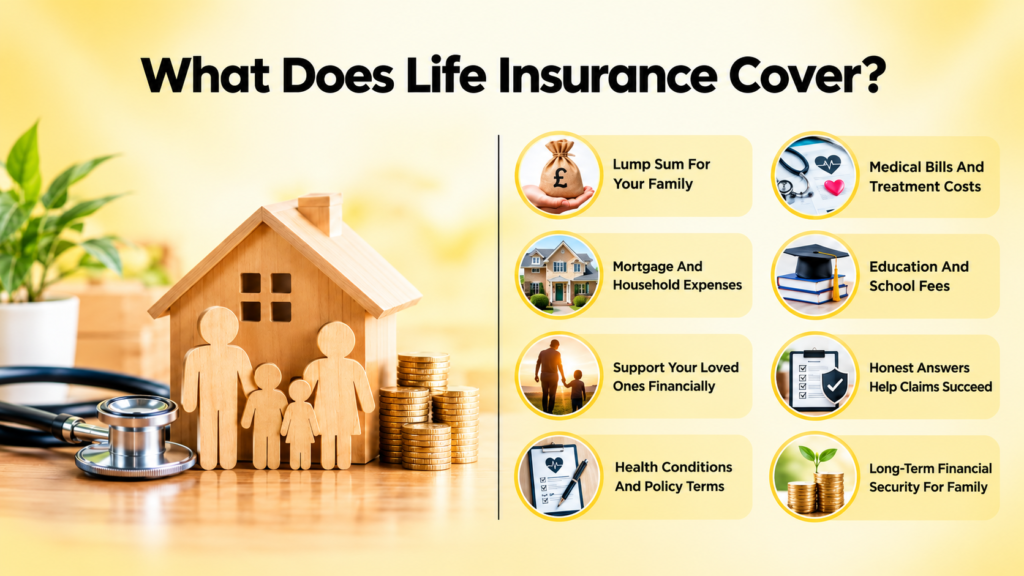
Life insurance pays a lump sum to your family if you die during the policy term. They can use it for the mortgage, school fees, funeral costs or everyday bills. Many policies also pay early if doctors say you have under 12 months to live.
Pick the type that matches what you want to protect:
- Level term: the payout stays the same until the policy ends. It suits interest-only mortgages and fixed family costs.
- Decreasing term: the payout falls over time, so it follows a repayment mortgage. It usually costs less.
- Increasing term: the payout rises with inflation.
- Family income benefit: pays your family a monthly income instead of one lump sum.
- Whole of life: pays whenever you die, as long as you keep paying. We advise on whole of life insurance for people who want cover with no end date
A trap on decreasing term that few people hear about. The policy shrinks your cover using an assumed interest rate. If mortgage rates rise above that assumption, your loan falls more slowly than your cover, and a gap opens. With the Bank of England deciding on rates this week, ask your mortgage and protection advisor which rate your policy assumes.
Two more points that decide whether a claim pays. Match the term to your mortgage, so the policy doesn’t end while you still owe money. And answer every health question fully and honestly. An insurer can refuse a claim if your answers were wrong.
Life insurance payouts are not subject to income tax. They can count towards your estate for inheritance tax, unless the policy is written in trust. Many insurers set this up when you buy.
What Does Critical Illness Cover Include?
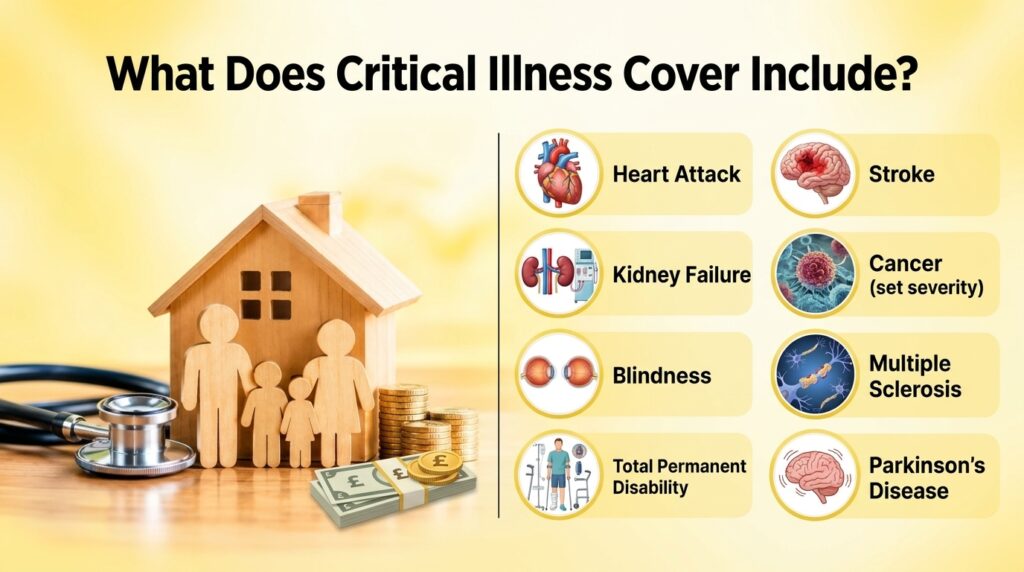
Critical illness cover pays you a tax free lump sum if you are diagnosed with, or have surgery for, a condition your policy lists, and you live past the survival period. You can spend it on anything: lost income, private treatment, childcare or the mortgage.
Most people compare the length of the condition list. That is the wrong test. Cancer is the biggest single reason people claim, so the policy of the cancer definition matters more than whether a policy lists 40 conditions or 50.
Most policies list cancer of a set severity, heart attack, stroke, multiple sclerosis, kidney failure, Parkinson’s disease, blindness and total permanent disability. The exact list changes by insurer. We arrange critical illness cover from several insurers, so you compare the policies one by one.
What it does not pay for:
- An illness that is not on your list, or is milder than the policy.
- A condition you already had when you applied.
- A death within the survival period, usually 10 to 14 days.
- Illness linked to drug or alcohol misuse, or dangerous activities, on many policies.
- Some early-stage cancers, which may pay a smaller amount or nothing.
There is one more gap. Most people stop work because of back problems or mental health conditions, and these often sit outside a critical illness list. If long term sickness is your main worry, ask about income protection alongside or instead of critical illness cover.
Are you confused about which insurance to choose: combined or separate?
A BM14 Finance adviser compares both options and explains which one suits your situation and your family.
Does Critical Illness Cover Breast Cancer?
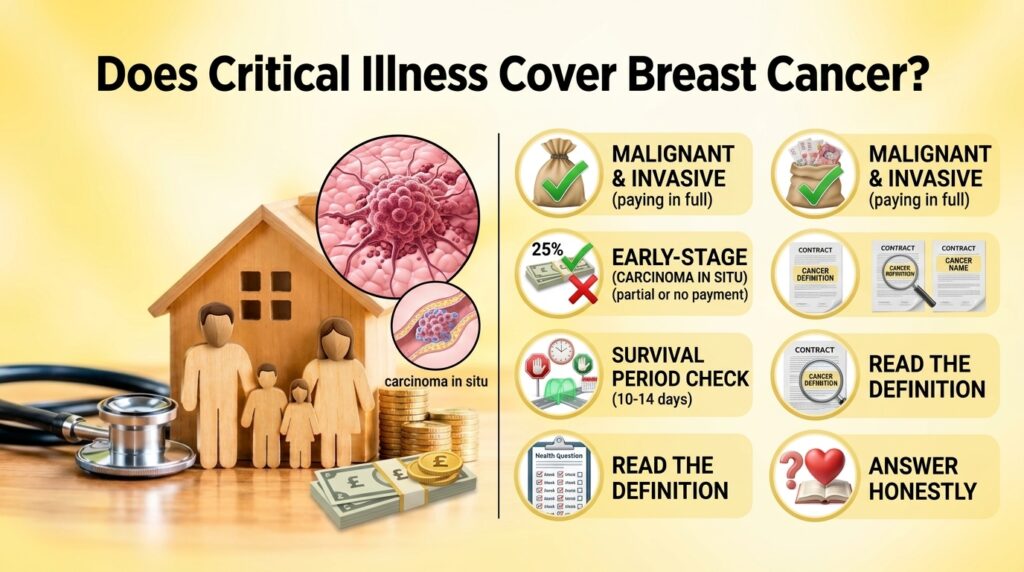
Yes, in most cases. Critical illness cover usually pays in full for breast cancer that is malignant and has invaded surrounding tissue. That matches the minimum cancer definition set by the ABI.
Early-stage breast cancer is where policies differ. This is called carcinoma in situ, or stage 0. Some insurers pay a smaller amount for it, often 25% or 30% of your cover, up to a cap of £25,000 or £30,000. Others pay nothing. A smaller payment usually does not end your main cover, so a later full claim stays possible.
Three checks before you buy:
- Read the cancer definition in the policy documents. The wording decides the claim, not the cancer name.
- Look for extra cover for early-stage cancers, and check how much it pays.
- Answer every health question honestly. If you have had breast cancer before, insurers may add a cancer exclusion or charge more.
The survival period applies here too, usually 10 to 14 days after diagnosis.
Children’s Critical Illness Cover
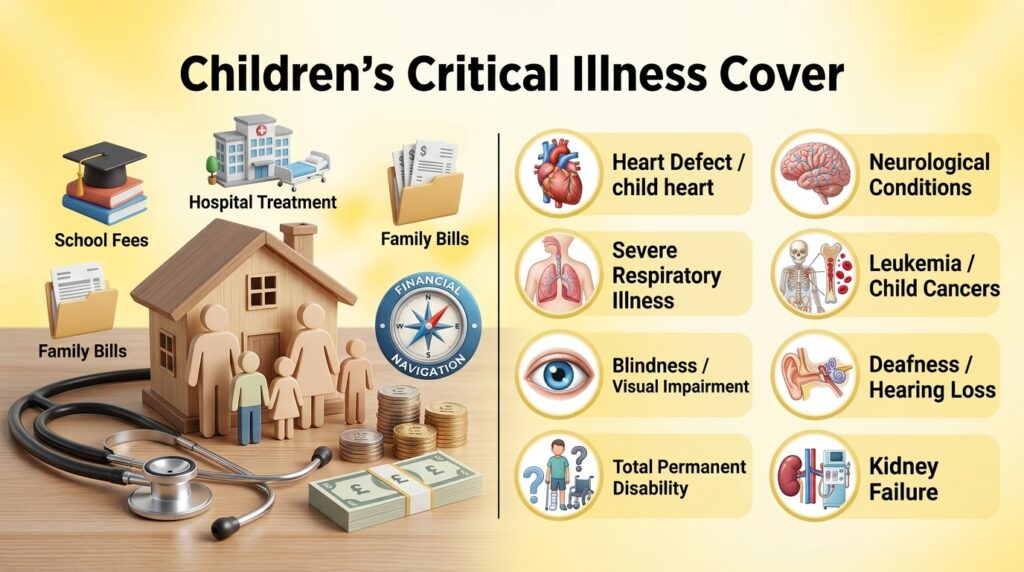
Children’s critical illness cover pays a lump sum if your child is diagnosed with a serious illness listed in your policy. You usually cannot buy it on its own. It comes with your own critical illness cover, either built in or as a paid add-on.
Here is how insurers set their own limits, so always check the policy:
- It is included at no extra cost. It is not a standalone policy.
- It pays the lower of 50% of your cover amount or £25,000.
- Children are covered from 30 days old to 18, or to 21 if they stay in full-time education. Children born later in the policy are covered too.
- Your child must survive at least 10 days after diagnosis.
- You can claim once per child. It counts as a partial claim, so your own cover carries on.
Combined Life and Critical Illness Insurance
A combined policy pays once, on whichever comes first: a listed illness or your death. After a full critical illness claim, it ends. Your family then gets nothing more from that policy when you die.
That is the part to think about before you pick the cheaper option. After a serious diagnosis, new life insurance is likely to cost much more, because insurers price in your health. So a combined policy can leave your family with no life cover at the moment they need it most.
Combined policy | Two separate policies | |
Number of payouts | One. The policy ends after the first full claim | Up to two, one from each policy |
After a critical illness claim | Life cover usually ends | Life cover carries on |
Cost | Usually lower | Often higher |
Choice of amounts | One sum assured and one term | Different amounts and terms for each |
How to choose:
- Combined suits you if you want one simple amount at a lower price, and a big illness claim would clear the mortgage anyway.
- Separate suits you if you want a large life policy for the mortgage and family, plus a smaller critical illness top-up, and you want the life cover to survive an illness claim.
Should High Earners Buy Critical Illness Cover Separately or Add it to Life Insurance?
High earners often prefer separate policies, because their income gap is bigger and they usually want life cover that survives a critical illness claim. Combined cover suits you when one payout would clear the mortgage and you want the lowest price. Your employer benefits and dependants help decide.
Buy critical illness cover separately when…
- Your income gap is bigger than your mortgage. If you would need two or three years of pay while you recover, you can set the critical illness sum at that figure and keep life cover for the mortgage and your family.
- Other people rely on your income. You want life cover to stay in place after an illness claim. After a serious diagnosis, new life cover is likely to cost much more.
- You want different amounts or terms. For example, life cover to the end of your mortgage and critical illness cover sized to your income.
- Your employer gives generous death in service. You may need little extra life cover, so you can buy critical illness cover on its own. Remember that death in service usually ends if you leave the job.
- You are self-employed or a company director. You usually have no employer sick pay or death in service, so cover has to be sized to your own income.
- You want your life policy in trust. A life payout can be written in trust for your family, but a critical illness payout comes to you. Keeping them separate can make this simpler.
- You have large debts beyond your mortgage, such as a business loan or buy-to-let borrowing.
Add critical illness cover to your life insurance when…
- Budget matters. A combined policy usually costs less.
- One payout would clear the mortgage, and your family would manage if the policy then ended.
- Your life and critical illness needs are about the same size and need to run for the same term, as with mortgage protection.
- You have other life cover, such as death in service and another policy, so losing this life element would not leave a gap.
- You prefer one policy, one premium and one claim.
- You have a repayment mortgage and want decreasing cover, which costs less.
Check these first
- How many months of full sick pay your employer gives, and what happens after.
- The death in service multiple, and whether it ends if you leave.
- How many months your savings would cover.
- Whether your partner’s income could carry the household for a year.
- Whether the sum you want looks reasonable against your income, because insurers can question amounts that look out of proportion.
- Whether the premium is guaranteed or reviewable.
- Whether income protection would help too, it pays a monthly income and is not tied to a list of conditions.
A BM14 Finance adviser can size your life cover and critical illness cover from your real figures and show you combined and separate quotes side by side. Book an appointment or call +44 789 567 7705.
Where Can I Buy Joint Life Insurance with Optional Children’s Critical Illness Cover and Multi-Fracture Protection?
You can buy joint life insurance with children’s critical illness cover through an insurance adviser, but not every insurer offers every feature. Fracture cover, including multiple fractures, is an optional extra at only some insurers. BM14 Finance checks which insurers currently offer the mix you want.
How the three pieces fit together
- Joint life insurance covers two people on one policy. It pays out once, on the first claim, and then ends, so the second person has no cover from it. Some couples buy two single policies instead, so each person keeps their own cover.
- Children’s critical illness cover is linked to your own critical illness cover. At some insurers it is free, at others it is an optional extra. The payout is capped, often at half your cover amount up to a set limit.
- Multi-fracture protection is an optional add-on at some insurers. It pays a smaller lump sum if you break a bone on the policy’s list, and the rules for more than one fracture differ by insurer.
How BM14 Finance helps
BM14 Finance offers a wide range of life insurance advice, including joint policies, critical illness cover and children’s cover. Meet us to talk through what you want to protect. We will compare the insurers that fit, explain the differences and recommend a policy that suits your family.
Joint or single? A joint policy covers two people for one premium, but it pays out once and then ends, leaving the other person uncovered. In its September 2026 final report, the FCA also told firms to consider the risk of economic abuse when recommending single or joint policies. In simple words, a policy in your own name stays yours if a relationship ends. A joint one is harder to untangle.
Not sure which to pick? Your specialist mortgage broker at BM14 Finance listens to your situation, explains each option and compares them for you.
Book an appointment now or you can call us.
Life Insurance and Critical Illness Cover for Mortgage Protection
You do not need life insurance or critical illness cover to get a UK mortgage. But your mortgage does not stop if you die or fall ill. That is why most people buy cover when they borrow.
- Life insurance pays off, or pays down, the mortgage if you die. Your family keeps the home.
- Critical illness cover pays you a lump sum if you are diagnosed with a listed illness. You can clear part of the loan or cover the payments while you recover.
Match the cover to your mortgage type:
Mortgage type | Cover that fits | Why |
Repayment | Decreasing term | Cover falls as your balance falls, and it usually costs less |
Interest-only | Level term | The loan stays the same, so the cover stays the same |
Three habits keep the cover and the loan in step:
- Match the policy term to the mortgage term. A 20-year policy on a 25-year mortgage leaves five years uncovered.
- Do not size critical illness cover to the whole mortgage by default. Covering the full balance that way is the costliest route. Many households cover the mortgage with life insurance and size critical illness cover to the income they would lose.
- Review the cover whenever the mortgage changes. A rate rise, an overpayment or a new deal doesn’t update your policy by itself.
Which Providers Offer Life Insurance That can Continue After Moving Home?
Most UK insurers’ life insurance policies continue after you move home, because the policy is not tied to your property. You just keep paying the premiums. BM14 Finance arranges life insurance whether you are moving or staying put, and can check that your cover still matches your mortgage.
Why your policy carries on
A life insurance policy is a contract between you and the insurer. It covers you, not your house. Moving home does not restart your health questions or change your price.
What to check after you move
- Your cover amount. If your new mortgage is bigger, your cover may no longer match the loan. Increasing cover means new health questions, unless your policy has an option to increase it, so ask before you assume.
- Your term. The policy should still run until the end of your new mortgage. If you have decreasing cover, check it still follows your new loan.
- Your address. Tell the insurer so your letters reach you.
- Living abroad. If you are moving abroad, check your policy terms first, because it can affect your cover.
Your buildings and contents insurance is different. That does need updating when you move.
Moving home or not, we can help
BM14 Finance provides life insurance whether you are moving home or staying where you are. Because we advise on mortgages and protection together, we look at your loan and your cover in the same conversation. Planning a move? Book an appointment or call +44 789 567 7705.
By the way, lenders usually want buildings insurance too. It protects the house, not you. Base it on the rebuild cost, which is what it would take in labour, materials and fees to rebuild from scratch, not on the market value. If you insure a home that costs £360,000 to rebuild for £300,000, you pay the £60,000 gap yourself after a claim. We also arrange building and contents insurance and check your rebuild figure.
Mortgage Protection Insurance Redundancy
Life insurance and critical illness cover do not pay if you lose your job. To cover redundancy, you need a different policy: mortgage payment protection (also called accident, sickness and unemployment cover) or income protection with an unemployment add-on.
The name “mortgage protection” confuses people. It can mean mortgage life insurance, which pays the loan off if you die. It can also mean payment protection, which covers your monthly payments if you can’t work. Always ask which one a quote means.
Check four things before you buy redundancy cover:
- Voluntary redundancy: most policies do not pay for it.
- Waiting period: you usually wait after the policy starts before you can claim.
- How long it pays: often 12 months or less, not until you find a new job.
- Known redundancy: you can’t insure against one you have already been told about.
Your home may be repossessed if you do not keep up repayments on your mortgage.
Protect your mortgage and your family in a single conversation.
We handle mortgages and protection together, so your cover matches your loan.
How to Calculate Rebuild Cost of House for Insurance
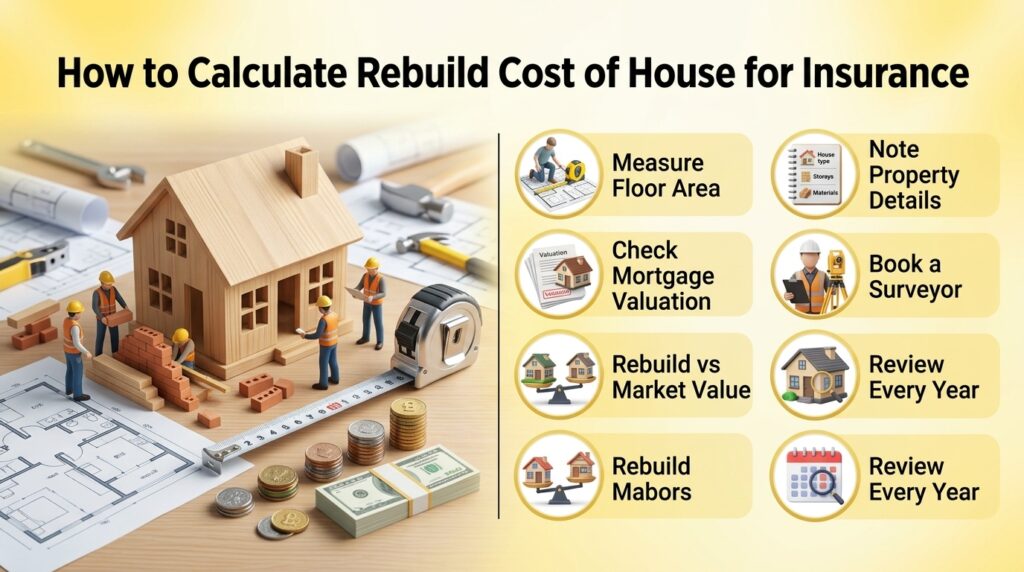
Your rebuild cost is what it would cost in labour and materials to rebuild your home from scratch if it were destroyed. It is not what your home would sell for. Buildings insurance is based on it, and many mortgage lenders ask you to have that cover.
How to work it out:
- Measure the floor area. Measure the length and width of your ground floor walls and multiply them. If the upstairs matches, double it. Add any converted loft or integral garage. A floor plan or your deeds can help.
- Note your property details. You need the type (house, bungalow or flat), the style (detached, semi-detached or terraced), the number of storeys and bedrooms, and the age and main building materials.
- Check your mortgage valuation. If you bought recently, the valuation report may already show a rebuild figure.
- Book a surveyor if your home is not standard. The calculator does not cover listed buildings, homes built before 1720 or timber-built homes. Flats and maisonettes may also need a surveyor. An RICS survey costs from a few hundred pounds to over £1,000.
- Review it every year. Check the figure at each renewal. After an extension or loft conversion, recalculate and tell your insurer before the work starts.
Rebuild cost and market value are different numbers:
- Rebuild cost includes labour, materials, professional fees, site clearance and current building regulations. It leaves out the land.
- Market value includes the land and your location, so it is usually higher.
Getting it wrong costs money either way. Set the figure too low and you face a shortfall after a claim. For example, if your home is insured for £300,000 but needs £360,000 to rebuild, you pay the £60,000 gap yourself. Set it too high and you pay more premium, with no bigger payout.
BM14 Finance also advises on building and contents insurance, so you can ask us to check your figure.
Can You Provide an Estimate of Critical Illness Insurance Premiums for a Non Smoker Seeking a Specific Sum Assured Over a 20 Year Term?
For a healthy non-smoker, £100,000 of life and critical illness cover over 20 years costs roughly £25 a month at age 30, £45 at 40 and just over £100 at 50. A critical illness only policy for a healthy 35 year old started at about £29 a month in late 2025. Your own price will differ.
What does it mean
- Sum assured: the lump sum the policy pays if you claim, for example £100,000.
- Term: how long the cover lasts. A 20-year term means you are covered for 20 years.
- Non-smoker: you have not used any nicotine, including vaping, for the last 12 months. Insurers’ rules differ slightly.
- Level cover: the payout stays the same for the whole term. Decreasing cover falls over time and costs less.
- Guaranteed premium: the price stays the same. A reviewable premium can go up later.
Example estimates for a healthy non-smoker
Cover | Age | Estimated monthly cost |
£100,000 life and critical illness, 20 years | 30 | About £25 |
£100,000 life and critical illness, 20 years | 40 | About £45 |
£100,000 life and critical illness, 20 years | 50 | Just over £100 |
£100,000 critical illness only, level cover, 20 years (late 2025 quotes) | 35 | About £29 to £53, depending on the policy |
These are examples, not quotes. Your price depends on your own details.
What changes your price
- Your age. Prices rise as you get older, so waiting costs more.
- Your health and family medical history.
- Smoking or vaping. Smokers pay more.
- The sum assured. A bigger sum costs more.
- The term. A longer term costs more.
- Level or decreasing cover. Decreasing cover costs less.
- Combined or critical illness only. Critical illness only costs less, but it pays nothing if you die.
- Extras. Optional extras such as fracture cover add to the monthly price.
Common worries, answered
- Will my price go up during the 20 years? Not with a guaranteed premium. It can with a reviewable one, so ask which you are quoted.
- What if I stop smoking? After 12 months with no nicotine, you can ask the insurer to treat you as a non-smoker, and the price usually drops.
- What happens if I claim? You receive the lump sum. The policy then ends and the payments stop.
- What if I change my mind? You can cancel within 30 days of the policy start date or of receiving your documents, and get your premiums back if you have not claimed.
- Is the cheapest quote the best? Not always. A low price hides fewer conditions or a stricter policy.
Get your own estimate
The quickest way to a real figure is to speak to a BM14 Finance adviser. Tell us your age, the sum you want, the term and your smoking status, and we will compare insurers for you. Contact BM14 Finance, or visit our London office at Berkeley Square House, Mayfair, or our Hempstead, Kent (ME7) office. Please book an appointment first, or call +44 789 567 7705.
Wondering what your cover would cost?
Your price depends on your age, health and cover amount. Talk to us for a personal quote.
Life Insurance and Critical Illness Cover Comparison: What to Check
Two policies at the same price can pay out in very different cases. The best one is the one that fits your mortgage, your family and your budget, not the one at the top of a price list. Check these seven things on every quote:
What to check | Why it matters |
Cancer definition and early-stage cancer terms | Cancer is the biggest reason for claims. Some policies pay a partial amount for early-stage cancer, some pay nothing |
Condition definitions | The policy decides the claim. A longer list is not always better |
Combined or separate | One payout or two, and what happens to your life cover after a claim |
Term and level or decreasing | The term should reach the end of your mortgage. Check the interest rate a decreasing policy assumes |
Premium type | Guaranteed premiums stay put. Reviewable premiums can rise |
Survival period | Usually 10 or 14 days. Shorter is better for you |
Children’s cover | Whether it is built in, and the payout per child |
You can buy direct, use a comparison site or use a protection adviser. Buying direct shows you one insurer’s plan. An adviser compares several, explains the policy and helps with the application.
One more check, if someone suggests replacing a policy you already hold. The FCA’s September 2026 report found poor practice at some intermediaries, including switching existing customers into new policies at the end of commission clawback periods. Switching can be right, for example if your needs changed. Ask the adviser to explain the reason in writing, and never cancel the old cover until the new one is live.
Too many policies to compare?
We compare insurers and condition lists, so you don’t have to worry.
Life Insurance and Critical Illness Cover Over 50
Yes, you can get life insurance and critical illness cover over 50. You apply for a standard policy, where the insurer checks your health, and you add critical illness cover to it. Age limits apply.
Do not mix this up with “over 50s life insurance”. That product guarantees acceptance with no health questions, and it exists to pay a lump sum when you die. It does not usually include illness cover.
Critical illness cover costs more at 50 than at 30, because illness is more likely. Your health history also counts, so answer every question honestly.
If your goal is to protect a mortgage or family income, a standard policy usually fits better.
When to Get Life Insurance and Critical Illness Cover
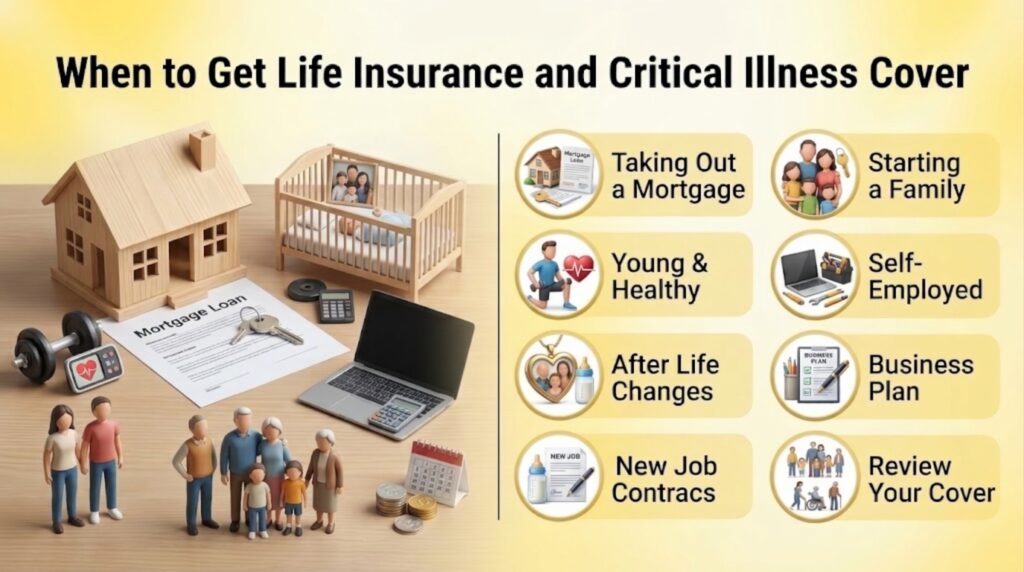 The best time is before you need it, because insurers will not cover an illness you already have. These are the moments when most people decide:
- When you take out a mortgage. If you die or fall seriously ill, the loan does not stop. Cover keeps your home safe.
- When you start a family. Once children depend on your income, protection stops being a nice extra.
- When you are young and healthy. Prices are lower and approval is easier. At 30, the example price starts around £15 a month.
- When you are self-employed. You usually have no employer sick pay or death in service benefit, so the gap is bigger.
- After a big life change. Marriage, a new job, a newborn baby or paying off a large debt are all good reasons to review your cover.
The best time to get cover is before you need it.
How to Get Life Insurance and Critical Illness Cover in the UK: Step by Step
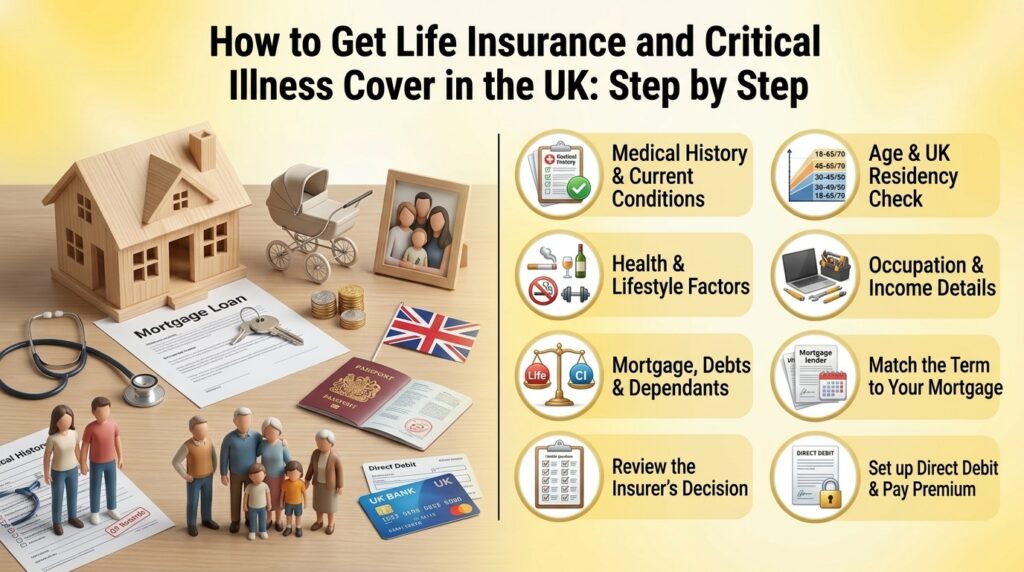
Getting life insurance or critical illness cover in the UK usually takes a few days to a few weeks. The steps are simple once you know what insurers ask for. This section covers who can apply, what you need, and how the process works from start to finish.
Who Can Get Life Insurance and Critical Illness Cover in the UK?
Every insurer have their own policy and rules, but most UK insurers look at the same things:
- Age: Most insurers accept adults from 18 up to around 65 to 70 for new policies. Critical illness cover often has a lower upper age limit than life insurance. The policy must also end before a maximum age, which differs by insurer.
- UK residency: You need to live in the UK. Some insurers also ask how long you have lived here and whether you plan to move abroad.
- Health: The insurer asks about your medical history, current conditions, medication, and recent tests or referrals. A health condition doesn’t always mean a refusal. It may mean a higher price or an exclusion.
- Lifestyle: Smoking or vaping status, alcohol use, height and weight, and risky hobbies such as climbing or diving all affect the decision and the price.
- Occupation: Some jobs, such as offshore work, the armed forces or work at height, may cost more or need extra questions.
- Financial need: Cover must make sense for your situation. You cannot insure yourself for any amount you like. The amount should match things like your mortgage, debts, income and dependants.
- Insurable interest: You can insure your own life. You can also insure a spouse, partner or someone who depends on you financially, with their consent.
- UK bank account: Most insurers collect premiums by Direct Debit from a UK bank account.
Your situation matters too. A mortgage holder, a parent, a self-employed person and a single person with no dependants all need different amounts and types of cover. That’s why the first step is working out what you actually need.
What to Have Ready Before You Apply
Gathering these first makes the application faster and more accurate:
- Full name, date of birth, address and contact details
- Your job title and annual income (self-employed people may need to show earnings)
- Mortgage details: lender, balance, term and whether it is repayment or interest-only
- Details of your dependants and any other debts
- Your height and weight, and your smoking and alcohol history
- Your medical history: conditions, medication, past operations, and any tests or referrals in the last few years
- Your family’s medical history, especially parents or siblings diagnosed with serious illness at a young age
- Any cover you already have, such as death in service or sick pay from your employer
Step 1: Work Out What You Need
Add up what your family would need if you died, or what you would need if you became seriously ill: your outstanding mortgage, living costs, childcare or school fees, debts and funeral costs. Then take away your savings and any cover from work.
Then decide the shape of the cover:
- Repayment mortgage: decreasing term cover usually fits.
- Interest-only mortgage or fixed family needs: level term cover fits better.
- Match the term to your mortgage. The policy should not end before the loan does.
Step 2: Decide Between Life Cover, Critical Illness Cover or Both
Life insurance pays when you die. Critical illness cover pays when you are diagnosed with a listed illness. You can buy them as separate policies or as one combined policy. A combined policy is usually cheaper, but it pays out once and then ends. Separate policies cost more but give you two payouts. If you are unsure, your adviser explains the trade off for your case.
Step 3: Speak to your Protection Adviser BM14 Finance
This is where we take the work off your hands. A BM14 Finance adviser will:
- Listen to your situation. We ask about your family, mortgage, income, savings and health so we understand what you need to protect.
- Check what you already have. This includes employer benefits, existing policies and mortgage commitments, so you don’t pay for cover you do not need.
- Compare insurers for you. Instead of contacting each company yourself, we compare policies, prices, condition lists, cancer definitions, survival periods and premium types across insurers.
- Discuss all available options. We show you the differences between policies and why one fits you better.
- Recommend the right cover. You get a clear suggestion with the reasons behind it, and you decide.
You can contact us on WhatsApp, call us, or book an appointment. Because we handle mortgages and protection together, we look at your loan and your cover in the same conversation.
Step 4: Complete the Application
Once you choose a policy, your adviser helps you complete the application. You answer questions about your health, family history and lifestyle. Insurers usually ask about “ever”, the last five years and the last 12 months.
Answer every question fully and honestly. If your answers are wrong or incomplete, the insurer can reduce or refuse a claim later. If you are unsure about a date or diagnosis, check your GP records first or tell your adviser.
Step 5: Underwriting
The insurer’s underwriters review your application. Depending on your answers, one of these happens:
- Instant acceptance: healthy applicants with simple answers are often accepted straight away.
- Further questions: the insurer may ask for more detail by phone or in writing.
- Medical evidence: it may request a report from your GP, or in some cases a medical exam.
This stage can take from a few days to a few weeks. Your adviser stays in touch with the insurer on your behalf and keeps you updated.
Step 6: Review the Insurer’s Decision
The insurer will make one of these decisions:
- Accepted as applied: your cover starts at the quoted price.
- Accepted with changes: the price may rise, or a specific exclusion may be added. Your adviser explains what this means and whether another insurer may offer better terms.
- Postponed or declined: this can happen with some serious or recent conditions. An adviser look at other insurers, because their rules differ.
Step 7: Start Your Policy
Once you accept the terms, set up your Direct Debit and pay your first premium. Then:
- Keep your policy documents somewhere safe.
- Tell your family or beneficiaries that the policy exists and where to find it.
- Ask your adviser whether writing the policy in trust suits you. A trust can keep the payout outside your estate for inheritance tax and often means your family gets the money faster.
Important Points to Remember
- Do not cancel an existing policy until the new one is active. Otherwise you may be left without cover.
- Check the premium type. Guaranteed premiums stay the same. Reviewable premiums can rise later.
- Read the condition definitions. The wording of a critical illness policy decides whether a claim is paid, not just the name of the illness.
- Check early-stage cancer cover. Some policies pay a smaller amount and some pay nothing.
- Use the cooling-off period. If you change your mind, you can cancel within 30 days of your policy start date or of receiving your documents, and get your premiums back if you have not claimed.
- Review your cover after big life events. Remortgaging, moving home, marriage, a new baby or a new job are all good moments to review.
- Neither policy covers redundancy. If you want protection for that, ask about mortgage payment protection or income protection with an unemployment add-on.
Why Speak to a Protection Advisor Before You Buy
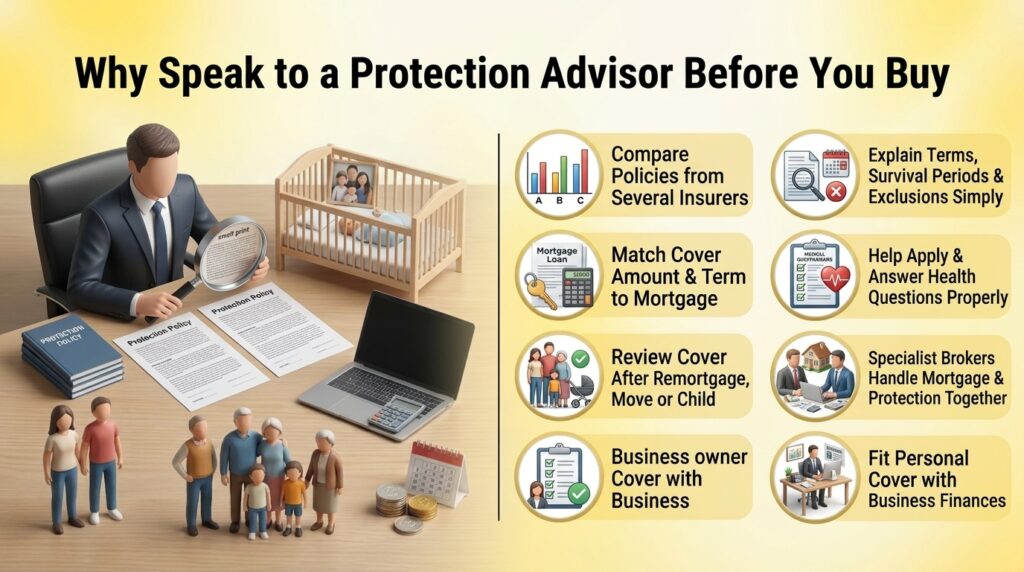
Two policies can look identical on a comparison page. The difference sits in the small print: the cancer definition, the early-stage terms, what happens to your life cover after a claim, and whether the premium can rise. A protection advisor reads that print and matches it to your situation.
An adviser (BM14 Finance) can:
- Compare policies from several insurers.
- Explain terms, survival periods and exclusions in plain language.
- Match the amount and term to your mortgage.
- Help you answer the health questions properly.
- Review your cover when you remortgage, move home or have a child.
BM14 Finance handles mortgages and protection together. A specialist mortgage broker and a protection advisor look at your loan and your cover in the same conversation. If you own a business, a business financial advisor (BM14 Finance) also talks through how personal cover fits with your business finances.
Ready to protect your family and your finances?
Speak to a protection adviser at BM14 Finance. We compare cover from several insurers and match it to your situation.
Talk to BM14 Finance About Life Insurance and Critical Illness Cover
Want help choosing? Speak to a protection advisor at BM14 Finance. We compare cover from several insurers, explain the insurance policy and match it to your situation.
Well, we cover 6 types of insurance advising services: life insurance, income protection, critical illness cover, over 50s cover, whole of life insurance and building and contents insurance.
Book an appointment or call +44 789 567 7705.
Where to find us:
Our first office is in Berkeley Square House, Mayfair, London W1J 6BD, UK, and 2nd office is in Hempstead, Kent (ME7). We support clients in London, Hempstead, Kent, and across the UK.
Note: Muhammad S. Rasheed T/A BM14 Finance is an Appointed Representative of Connect IFA Limited, which is authorised and regulated by the Financial Conduct Authority (reference 1040560). Your property may be repossessed if you do not keep up repayments on your mortgage.
Frequently Asked Questions
Is critical illness cover worth it if I already have life insurance?
Often, yes. Life insurance pays only when you die, so it pays nothing if you are diagnosed with a serious illness and survive. Critical illness cover fills that gap with a lump sum while you are alive. Whether it is worth the cost depends on your savings, your sick pay and who relies on your income.
Which is better, critical illness insurance or life insurance?
Neither wins in every case. Life insurance usually comes first if other people depend on your income or share your mortgage. Critical illness cover moves up the list when a year without your income would be hard to absorb. Many households end up with both.
Is Statutory Sick Pay enough if I fall seriously ill?
No. From 6 April 2026 it pays the lower of £123.25 a week or 80% of your normal earnings, for up to 28 weeks. Self-employed people get none. Check your contract for what your employer pays on top.
How much does life insurance and critical illness cover cost in the UK?
In example quotes, a healthy non-smoker aged 30 pays roughly £15 a month for £50,000 of combined cover over 20 years. The price rises with age, health risks and cover amount. Only a personal quote gives your exact price.
Can I get life insurance with a pre-existing medical condition?
Usually yes, although the price may be higher or the insurer may add exclusions. Always tell the insurer about your conditions. Wrong answers can lead to a refused claim.
What conditions does critical illness insurance cover?
Most policies list cancer, heart attack, stroke, multiple sclerosis and kidney failure, among others. The number of conditions varies by insurer, and Aviva, for example, lists 52. Compare the full list and the definitions, not only the headline number.
What is the survival period on critical illness cover?
It is the number of days you must live after diagnosis before the policy pays. It is usually 10 or 14 days, depending on the insurer.
Do I need critical illness cover if I’m self-employed?
Many self-employed people consider it, because they usually have no employer sick pay or death in service benefit. Your savings and your outgoings decide how much you need.
How much life insurance cover do I need?
Start with your outstanding mortgage, your debts, your family’s living costs, childcare and funeral costs. Then take away your savings and any cover from work.
Does critical illness cover pay out more than once?
Most policies pay the full amount once, then end. Some pay smaller extra amounts, for example for early-stage cancer or a child’s claim, without ending your main cover. Check your policy wording.