

When people think about life insurance, they usually picture cover that lasts for a fixed number of years. But not every family goal has an expiry date.
Some people want the certainty that their loved ones will get a payout no matter when they pass away, whether that’s in 10 years or 50. This is where whole of life insurance comes in.
At BM14 Finance, we help individuals and families in London and Hempstead, Kent, UK understand their protection options and find cover that fits their long-term goals.
What Is Whole of Life Insurance?

Whole of life insurance is a type of permanent life insurance that stays active for your entire lifetime, not just a set number of years.
As long as you keep paying your premiums, the insurer guarantees your beneficiaries will receive a payout, it’s simply a question of when, not if. This certainty is the main reason families choose it over term cover, especially for goals like funeral planning or leaving money behind for children.
Because a payout is guaranteed eventually, whole of life insurance usually costs more each month than term insurance, which only pays out if you die within a fixed period.
How Does Whole of Life Insurance Work?
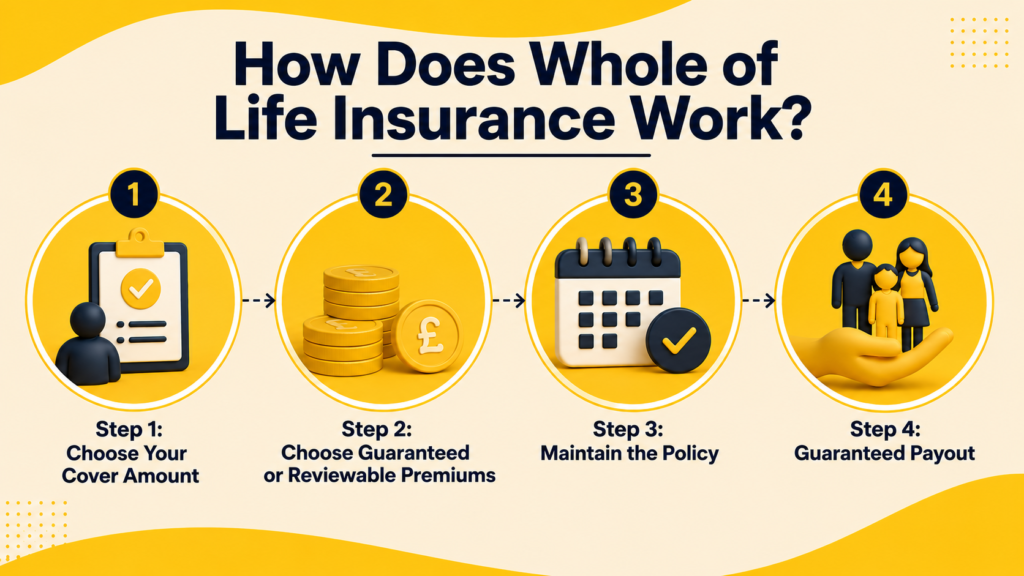
You choose a cover amount, pay regular premiums, and your beneficiaries receive that amount whenever you die, provided the policy has stayed active.
The process behind a whole of life policy is simple once you break it down into four stages, from choosing your cover to the final payout:
- You decide how much cover you need; usually based on funeral costs, outstanding debts, or how much you’d like to leave behind for your family.
- You agree a premium with the insurer: based on your age, health, income, and how much cover you’ve chosen.
- You keep paying your premiums on time: as long as this continues, your policy stays active automatically in the background, with nothing else for you to do.
- The insurer pays out when you die: your beneficiaries receive the agreed lump sum directly, provided the policy terms have been met.
Step 1: Choose Your Cover Amount
This is the amount your loved ones will receive when you pass away, so it’s worth thinking through carefully rather than picking a round number at random. Most people base this figure on:
- Funeral and burial or cremation costs
- Any outstanding debts, such as a mortgage balance or loans
- A lump sum they’d like to leave behind for a partner, children, or grandchildren
- An estimated inheritance tax bill, if IHT planning is part of the goal
You can usually adjust this amount before the policy starts, and some insurers allow it to be reviewed later, though increasing cover further down the line may involve new health questions.
Step 2: Choose Guaranteed or Reviewable Premiums
This decision affects what you pay not just today, but for the rest of the policy’s life, so it’s worth understanding properly before signing anything:
- Guaranteed premiums stay fixed for the entire life of the policy, no matter how your age or health changes later.
- Reviewable premiums usually start lower, but the insurer can increase them at set review points, often every five to ten years.
Guaranteed premiums tend to suit people who want predictable, long-term budgeting, while reviewable premiums can suit those prioritising a lower cost now over certainty later.
Read this guide if you are confused about how to choose the right life insurance policy in the UK.
Step 3: Maintain the Policy
Once your policy is set up, keeping it active is straightforward:
- Premiums are usually collected monthly by direct debit.
- Missing payments can put your cover at risk of lapsing, so it’s worth setting up reminders or automatic payments.
- Cover continues automatically for as long as premiums are maintained, there’s no renewal process to worry about, unlike some other insurance products
Step 4: Guaranteed Payout
When the policyholder passes away, the insurer pays the agreed lump sum to the named beneficiaries. This payout is usually:
- Paid as a single tax-free lump sum (subject to how the policy and estate are structured)
- Paid out faster if the policy has been written in trust, since this avoids the probate process
- Paid directly to beneficiaries rather than through the estate, again if written in trust
Guaranteed vs Reviewable Premiums: What’s the Difference?
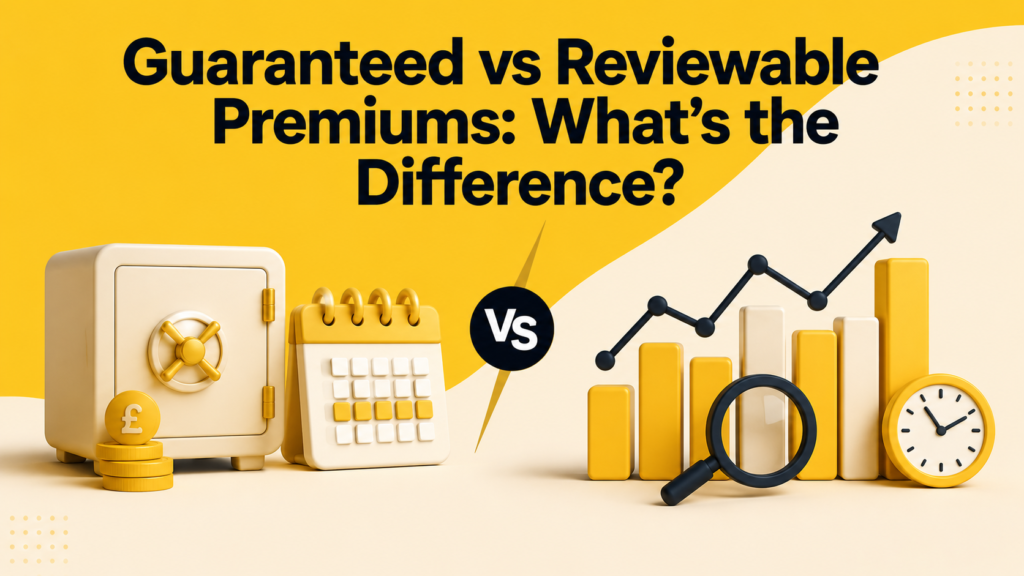
This is one of the most important decisions within a whole of life policy, and one most guides skip past too quickly.
Guaranteed premiums stay exactly the same for the entire life of the policy. You’ll typically pay a bit more in the early years, but you’re protected from any future increases, no matter your age or health changes later on. This makes budgeting simple, which is why guaranteed premiums tend to suit people who want long-term certainty, particularly older applicants or those on a fixed income in retirement.
Reviewable premiums usually start lower, which can make them tempting. But the insurer reviews the cost periodically, often every five or ten years, and can raise your premium based on your age and updated risk. Over a few decades, reviewable premiums can end up costing considerably more than guaranteed premiums, and in some cases can become unaffordable later in life, forcing people to reduce their cover or cancel altogether.
Quick summary:
- Choose guaranteed premiums if long-term certainty and predictable budgeting matter most to you
- Choose reviewable premiums if you want a lower cost now and are comfortable with the possibility of increases later
- Always check exactly how and when reviews happen before committing to a reviewable policy
Whole of Life Insurance vs Over 50s Life Insurance?

These two are easy to confuse, but they’re built for different situations.
Over 50s life insurance is a specific type of whole of life cover designed for people aged 50 to 80, usually with guaranteed acceptance and no medical questions. Cover amounts tend to be smaller, often aimed at covering funeral costs rather than a large legacy, and the trade off is that premiums are often higher relative to the cover you get. Standard whole of life insurance, by contrast, usually involves full medical underwriting, can offer much larger cover amounts, and tends to work out better value for people in reasonably good health.
- Choose over 50s cover if you mainly want funeral costs covered and guaranteed acceptance regardless of your health
- Choose standard whole of life insurance if you want larger cover, better value for money, and you’re comfortable answering health questions
Why Do People Choose Whole of Life Insurance?
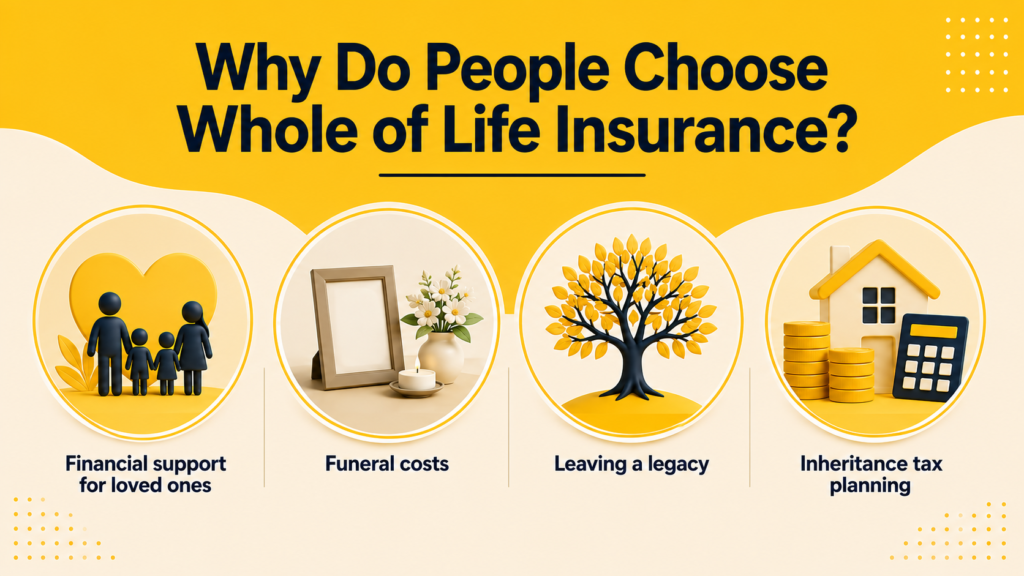
Families choose whole of life insurance for the certainty it offers, a payout that’s guaranteed to arrive whenever it’s needed most, not just within a set number of years.
- Financial support for loved ones; the payout can help your family manage day-to-day costs and financial pressure at a time when they’d otherwise be least able to cope with money worries.
- Funeral costs; UK funeral costs have continued to rise in recent years, and many families use whole of life insurance specifically so this expense doesn’t fall on loved ones.
- Leaving a legacy; some policyholders use their payout to leave a financial gift for children or grandchildren, separate from the rest of their estate.
- Inheritance tax planning; whole of life insurance is one of the most common policies used in UK inheritance tax (IHT) planning, particularly when a policy is written in trust.
Using Whole of Life Insurance for Inheritance Tax Planning

If your estate is likely to exceed the UK’s inheritance tax threshold, whole of life insurance can be used to cover the tax bill your beneficiaries would otherwise have to pay.
Here’s how it typically works:
- You take out a whole of life policy for a cover amount roughly equal to your expected IHT liability
- When you die, the policy pays out and your family can use that money to settle the inheritance tax bill
- This usually means your family doesn’t need to sell property or other assets under time pressure
- It matters because HMRC generally expects inheritance tax to be paid before probate is granted, which can otherwise leave families in a difficult cash-flow position
Writing the policy in trust is a key part of this strategy. When a policy is placed in trust:
- The payout goes directly to your beneficiaries rather than becoming part of your estate
- It isn’t itself subject to inheritance tax
- It can be paid out faster, since it avoids the probate process
Trust rules can be complex and depend on individual circumstances, so this is usually something worth discussing with a qualified adviser rather than setting up alone.
Who Should Consider Whole of Life Insurance?
Whole of life insurance tends to suit people who want lifelong certainty rather than temporary protection, though the right choice always depends on individual circumstances. It’s commonly considered by:
- Parents wanting long-term family protection
- People planning inheritance tax strategies
- Individuals wanting guaranteed funeral funding
- Business owners seeking long-term protection
- Families who value financial certainty over lower short-term costs
If you only need cover for a specific period, such as while paying off a mortgage, term insurance is usually the more cost-effective option instead.
How Much Does Whole of Life Insurance Cost in the UK?
Whole of life insurance premiums vary widely because they depend on your personal circumstances, not a fixed price list. The main factors insurers weigh up include:
- Your age at application
- Current health and medical history
- The cover amount you choose
- Whether you pick guaranteed or reviewable premiums
As a general guide, a healthy non-smoker in their 40s or 50s applying for a modest cover amount will usually pay noticeably less than someone applying in their 70s or with health conditions, since the insurer’s risk of an earlier payout is lower. Starting a policy younger almost always means locking in a lower premium, which is one of the main reasons advisers recommend not delaying the decision once you know you want lifelong cover.
A whole of life insurance calculator can give you a rough starting estimate based on your age and desired cover amount, which is a useful first step before speaking to an adviser. However, a whole of life insurance calculator UK can only ever provide a ballpark figure, since it doesn’t account for your full medical history or lifestyle for an accurate whole of life insurance quote, full underwriting is needed.
Because whole of life insurance guarantees an eventual payout, premiums are structurally higher than term life insurance for the same amount of cover. If you’re comparing options, finding the best whole of life insurance UK deal for your circumstances usually comes down to balancing cover amount, premium type, and long-term affordability, rather than simply picking the cheapest starting price.
Whole of Life Insurance vs Term Life Insurance
| Feature | Whole of Life Insurance | Term Life Insurance |
| Cover Duration | Lifetime | Fixed period |
| Guaranteed Payout | Yes | Only if death occurs during the term |
| Monthly Cost | Higher | Lower |
| Premium Types | Guaranteed or reviewable | Usually fixed for the term |
| Best For | Legacy, funeral costs, IHT planning | Mortgages, temporary financial responsibilities |
| Suitable for Estate Planning | Yes | Limited |
In short: term insurance protects you for a set period at a lower cost, while whole of life insurance protects you permanently at a higher cost. Many UK families use term insurance while a mortgage or younger creating short-term financial risk, then consider whole of life cover once they’re focused on legacy and estate planning instead.
Advantages of Whole of Life Insurance
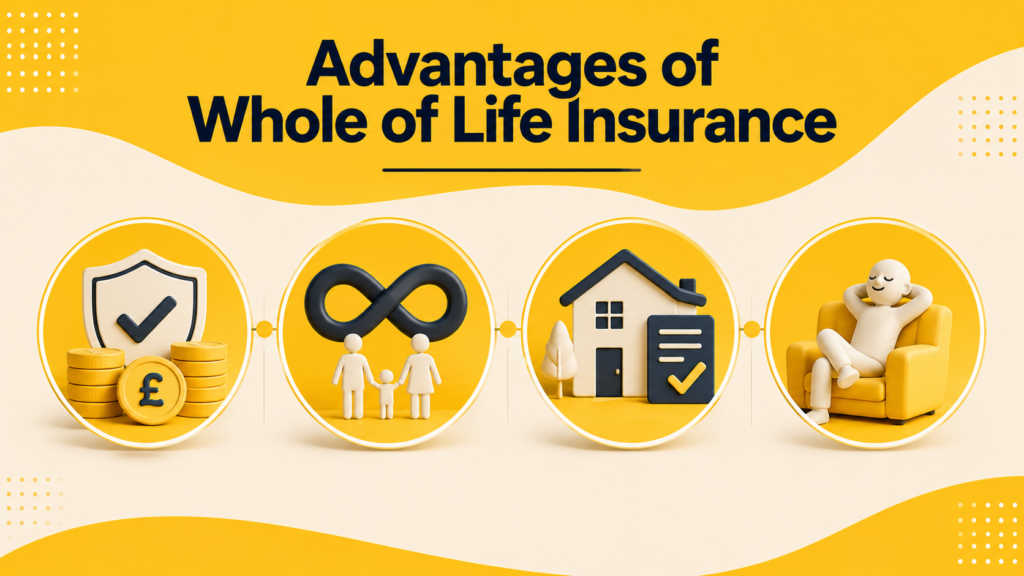
- Guaranteed payout; as long as policy conditions are met, your beneficiaries will receive the payout, it’s not a case of hoping you outlive a fixed term.
- Lifelong protection; there’s no risk of your cover expiring after a set number of years, unlike term insurance.
- Estate planning benefits for many families, whole of life insurance forms a key part of broader inheritance and wealth transfer planning.
- Peace of mind knowing financial support will be there for your family whenever it’s needed, rather than only within a fixed window, is often the biggest reason people choose this type of cover.
Potential Disadvantages of Whole of Life Insurance
- Higher premiums; whole of life insurance generally costs more each month than term cover for the same payout amount.
- Long-term commitment; policies are designed to stay active for life, so premiums are typically an ongoing cost rather than a short-term one.
- Reviewable premiums can rise sharply; costs can increase considerably at each review point, sometimes becoming unaffordable in later life if not carefully considered upfront.
- Not suitable for everyone; if you only need protection for a temporary period, such as while paying off a mortgage, term insurance is usually more cost effective.
Why Many UK Families Still Prefer Whole of Life Insurance Policy?

Despite higher premiums, many UK families continue choosing whole of life insurance policy because of the certainty it guarantees. That certainty can mean:
- Funeral costs are covered without falling on loved ones
- Family members receive financial support exactly when they need it
- A financial legacy is passed on to children or grandchildren
- Inheritance tax planning objectives are met without forcing a rushed sale of assets
Frequently Asked Questions
What is the whole of life insurance policy?
It’s a permanent life insurance policy that guarantees a lump-sum payout to your chosen beneficiaries whenever you die, as long as premiums are kept up to date. It has no fixed end date, unlike term insurance.
What is meant by whole life insurance?
Whole life insurance means cover that lasts for your entire life rather than a set number of years. Premiums are paid for as long as the policy runs, and a payout is guaranteed to be made eventually.
What is the catch of the whole life insurance?
The main catch is that premiums are higher than term insurance because a payout is guaranteed. If you choose reviewable premiums, costs can also rise significantly at later review points.
Is whole of life insurance worth it?
It depends on your goals. If you want guaranteed lifelong cover for funeral costs, legacy planning, or inheritance tax, it’s often worth the higher premiums. If you only need short-term cover, term insurance is usually better value.
What is the disadvantage of whole life insurance?
The biggest disadvantages are higher monthly premiums compared to term cover and the long-term financial commitment, since policies are designed to run for the rest of your life.
What happens after 20 years of whole life insurance?
Nothing changes automatically, the policy simply continues as normal. Unlike term insurance, whole of life cover doesn’t expire after a set number of years; it keeps running as long as premiums are paid.
Can I withdraw money from whole life insurance?
Standard UK whole of life insurance is protection-only and has no cash value to withdraw. Some older investment-linked whole of life policies did include a savings element, but these are rarely offered by insurers today.
Who needs whole life insurance?
It tends to suit people who want guaranteed lifelong cover, such as those planning for funeral costs, inheritance tax, or leaving a financial legacy, rather than those who only need protection for a fixed period like a mortgage term.